Memories and ReflectionsI don't know where in Ireland my great-grandfather, Thomas O'Hara, was born or exactly when he arrived in Canada. He married in Ottawa (then Bytown) Ontario, November 6, 1843 at the age of 25. So he possibly arrived about 1839, in time to escape the Irish Potato Famine. It would be nice to know something of his trip up the Ottawa River from Montréal or did he come via the Rideau Canal? And what about his experience as a pioneer in the Ottawa Valley? I can infer something of how he prospered by reading his will. Thomas O'Hara's descendents are all across North America as are the descendents of my mother's side of the family. Maybe in years to come someone related to me will wonder what my life was like, spanning most of the 20th century and into the 21st. So, in case it is of interest to anyone, here are some of the highlights of my life.
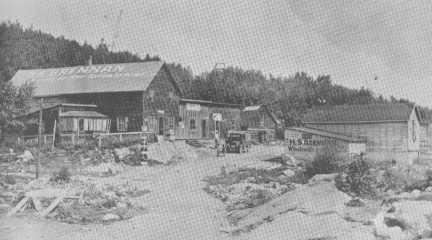
My father worked for my mother's brother and his wife who owned a wholesale and retail grocery business in Silver Centre. My uncle's name was Hubert Brennan. He must have been proud of his name, judging by the sign on the roof of their store. My parents moved further north and opened a grocery store in a place with the unlikely name of Swastika. My first memories are from there. Unfortunately, my father was too kind hearted with credit when the Great Depression of the 30's hit. He continued to give credit to destitute people. He lost the store and was lucky enough to get a job working five miles away at the Lake Shore Mine in Kirkland Lake . Lucky is a relative word. I can remember my mother pounding my father's back to get the muscles to relax. He was not used to "mucking" which is what they called shovelling rock underground in the dark and dampness for an eight hour shift in a gold mine. He peddled a bike back and forth the five miles to work. Imagine that in the freezing cold of a Northern Ontario Winter. He liked to write poetry but there is nothing from that period. In the
middle of the village, next to the railway station was a
Frank Age 2
1933
|
|---|
 I was born in a mining
town called Silver Centre, about 35 miles from Cobalt in Northern Ontario. My
mother said the log house had cracks that the Winter wind whistled through. In
the mid 1960's I went on a camping trip with my family to that region and tried
to find the town. I found the general vicinity and there were still signs of a
mine but the bush had grown up and I could not find where the town had been. It
gives a person a sense of his impermanence!
I was born in a mining
town called Silver Centre, about 35 miles from Cobalt in Northern Ontario. My
mother said the log house had cracks that the Winter wind whistled through. In
the mid 1960's I went on a camping trip with my family to that region and tried
to find the town. I found the general vicinity and there were still signs of a
mine but the bush had grown up and I could not find where the town had been. It
gives a person a sense of his impermanence! 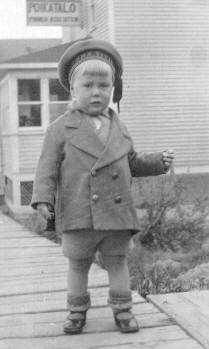 very small garden in the middle of what
might have been called a traffic circle, had there been enough traffic to
warrant it. In the centre of the little park (about five yards square) was a
flag pole with the Union Jack flying. Of course, at that time Canada did not
have a flag of our own. We were all British subjects. The station master who
happened to have been born in Germany liked flowers and had time to spare so he
thoughtfully created a very attractive swastika of flowers, with the flag pole
exactly in the middle. Very attractive to the train passengers and the
townspeople. No one thought anything of this before 1939 and when the war came
along no one could tell the station master to change the design and if he did
it would have appeared that he actually had Nazi sympathies. The paradox
continued well into the war when they changed the name of the town to Winston.
The garden was not nearly so interesting after that. After the war the name
Swastika was re-instituted but not the flower garden.
very small garden in the middle of what
might have been called a traffic circle, had there been enough traffic to
warrant it. In the centre of the little park (about five yards square) was a
flag pole with the Union Jack flying. Of course, at that time Canada did not
have a flag of our own. We were all British subjects. The station master who
happened to have been born in Germany liked flowers and had time to spare so he
thoughtfully created a very attractive swastika of flowers, with the flag pole
exactly in the middle. Very attractive to the train passengers and the
townspeople. No one thought anything of this before 1939 and when the war came
along no one could tell the station master to change the design and if he did
it would have appeared that he actually had Nazi sympathies. The paradox
continued well into the war when they changed the name of the town to Winston.
The garden was not nearly so interesting after that. After the war the name
Swastika was re-instituted but not the flower garden.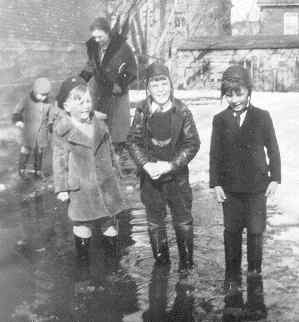 In the Dirty Thirties, most people were poverty stricken,
and my family was no exception. We lived a very basic life in the mining towns
of Swastika and Kirkland Lake in Northern Ontario. However, that summer, my
father came into a bit of money, I think by selling some gold mining claims or
perhaps from dad's father's estate (died in 1932). My parents used some of this
windfall to send my brother Brian, and me to a summer camp for boys near
Ottawa. Bill and Tom, of our two Ottawa cousins, joined us. (That's Tom in the
middle and Bill on his left. It was an exciting adventure in the South for two
boys from the North.
In the Dirty Thirties, most people were poverty stricken,
and my family was no exception. We lived a very basic life in the mining towns
of Swastika and Kirkland Lake in Northern Ontario. However, that summer, my
father came into a bit of money, I think by selling some gold mining claims or
perhaps from dad's father's estate (died in 1932). My parents used some of this
windfall to send my brother Brian, and me to a summer camp for boys near
Ottawa. Bill and Tom, of our two Ottawa cousins, joined us. (That's Tom in the
middle and Bill on his left. It was an exciting adventure in the South for two
boys from the North. 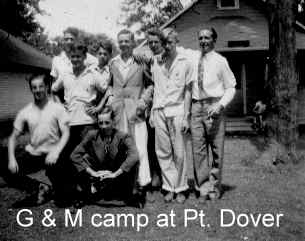 The other was a trip to Toronto by train to visit
The Globe and Mail's nerve centre on King Street, followed by a one-week,
all-expenses-paid vacation at The Globe's summer camp at Port Dover on Lake
Erie. I still remember the amazing image of newspapers streaming through the
giant presses and the luxurious (by my standards) cabins at Port Dover. (I was
used to camping in a prospector's tent in the bush.)
The other was a trip to Toronto by train to visit
The Globe and Mail's nerve centre on King Street, followed by a one-week,
all-expenses-paid vacation at The Globe's summer camp at Port Dover on Lake
Erie. I still remember the amazing image of newspapers streaming through the
giant presses and the luxurious (by my standards) cabins at Port Dover. (I was
used to camping in a prospector's tent in the bush.) 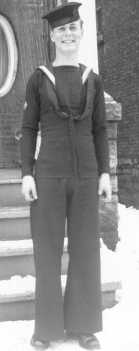 Two weeks into basic
training in Montréal, Quebec, we raw recruits were roosted from our
bunks, issued bayonets in scabbards, warned the weapons were just for show,
loaded into open trucks, and sent to quell a riot at a Dorval dance hall.
Two weeks into basic
training in Montréal, Quebec, we raw recruits were roosted from our
bunks, issued bayonets in scabbards, warned the weapons were just for show,
loaded into open trucks, and sent to quell a riot at a Dorval dance hall.
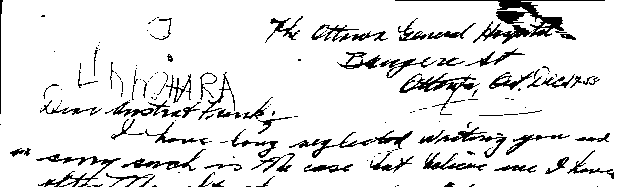
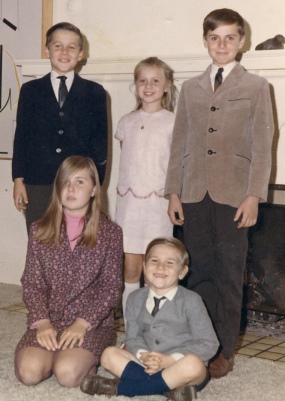
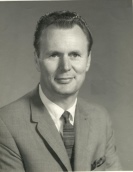 Following my graduation from the University
of Toronto in 1948 I held a number of unsatisfactory jobs until 1953, when I
joined Moore Business Forms Ltd. as a salesman. I spent some 16 years there and
was quite successful as a salesman, sales supervisor and latterly Toronto
branch manager. Looking back, I didn't realize that I left that good job as a
by-product of my marriage break-up. I joined my cousin, Tom McLaughlin, in a
new enterprise that placed audio visual projectors in Canadian embassies around
the world. The object was to have provinces, and the federal government promote
industrial development across Canada. In a word, this did not
succeed.
Following my graduation from the University
of Toronto in 1948 I held a number of unsatisfactory jobs until 1953, when I
joined Moore Business Forms Ltd. as a salesman. I spent some 16 years there and
was quite successful as a salesman, sales supervisor and latterly Toronto
branch manager. Looking back, I didn't realize that I left that good job as a
by-product of my marriage break-up. I joined my cousin, Tom McLaughlin, in a
new enterprise that placed audio visual projectors in Canadian embassies around
the world. The object was to have provinces, and the federal government promote
industrial development across Canada. In a word, this did not
succeed. I had
had a longstanding interest in photography and with the above exposure to audio
visual programs, in 1970, I launched O'Hara Management Services Ltd. That
company evolved into O'Hara Systems Inc. to produce multimedia programs (touch
screen systems). We didn't set the world on fire but we did earn some
international awards. This company happened to be at the very outset of the
Internet. As a result, in the early 1990's we started to produce websites. So I
pioneered multimedia and website development. Pioneers don't usually get as
rich as the followers on. I qualified as the former.
I had
had a longstanding interest in photography and with the above exposure to audio
visual programs, in 1970, I launched O'Hara Management Services Ltd. That
company evolved into O'Hara Systems Inc. to produce multimedia programs (touch
screen systems). We didn't set the world on fire but we did earn some
international awards. This company happened to be at the very outset of the
Internet. As a result, in the early 1990's we started to produce websites. So I
pioneered multimedia and website development. Pioneers don't usually get as
rich as the followers on. I qualified as the former.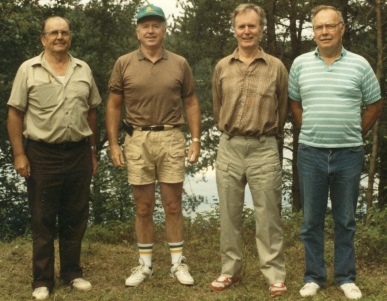 |
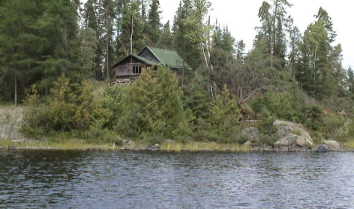 |
This is a photo of Brian, Gerry, Frank, Jack, the four O'Hara "boys", as the people up north called us when we visited our cabin in the bush near Kirkland Lake, Ontario. We were "boys" when we first started going up there, these many years ago. Weren't we a healthy looking crew in 1990? As I write this Gerry and I are still in the land of the living but we've passedon the cabin and the mining claims, on which it stands, to the next generation.

2003
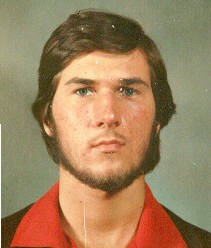 My son, Andrew, died while taking a nap on
Sunday afternoon March 2, 2003. He had turned 42 on February 24th.
My son, Andrew, died while taking a nap on
Sunday afternoon March 2, 2003. He had turned 42 on February 24th.
Andrew developed schizophrenia at age 19 when he was in his second year at university. He always thought he would be able to go back to school one day but his illness made it impossible. The last eight years or so were not too bad. He had a small apartment near the psychiatric hospital and was able to go to the hospital each morning for his medication. However, he was unable to do any work. He collected a government disability pension known as "Family Benefits". I had made arrangements for him to pick up his breakfast each morning at the hospital and get his medication at the same time. Prior to that arrangement, as is common with those with schizophrenia, he would go off his medication and end up in the hospital for about a month while they stabilized him. He went through literally dozens of boarding houses on that basis. He was a big fellow, at least 6' 2" and over 200 pounds and could look intimidating but he was actually quite gentle.
My daughter Kathryn was a great support at this time. We arranged to have Andrew's body cremated. My second wife, Jean, with her husband, Bruce Robertson were there with Kathy and me. In addition, a social worker from the mental hospital, Stephen Willoughby, who had worked with Andrew for some years came to the little ceremony. As well, two people who worked at the apartment building (assisted housing) where Andrew stayed, came along. It is wonderful that there are kind and considerate people like these who work in trying circumstances and receive little to no positive feedback. Saintly is the word that comes to my mind. There are many of these people who work on the margins of our society. Too bad we hear so much about the people who cause problems and not enough about the people who tend to the downtrodden.
We didn't have any kind of conventional ceremony. There were only seven of us in the small chapel next to the crematorium. We talked about Andy. I was reminded of him as a child. When I find it I intend to display a picture of Andy when he was about 5 years old. He was fishing on the dock of our cabin up North. His attention was riveted on the end of his fishing line. It illustrated an element of his personality that remained even through his illness. He was also very neat about his room when he was growing up and, surprisingly, his apartment showed this quality still. There were too many odds and ends but each item had its place, even the dishes in his cupboard were evenly spaced on the shelves. As a youngster Andy was a trader. He was buying and selling used cars before he was old enough to have a driver's licence. For his apartment he was continually buying used items and trading up to better ones. He had a few eccentricities. For example, in the summer he almost always wore a flower in his lapel (lifted from nearby gardens). He had about a dozen hats and always wore one; his favourite was a "Sherlock Holmes" one, which he ported along with his "Sherlock Holmes" pipe (again one among many). He wore a scarf, even in the summer time.
Afterwards we came to my apartment where we toasted Andrew, reminisced about him and shared some food.
It would be nice to believe that Andrew has moved on to a better place. He certainly earned it.
2003
On a happier note.....
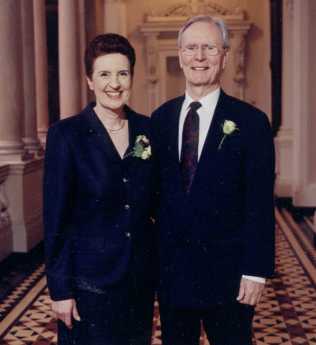
Marion E.
Raycheba and I were married on April 2, 2003
I've had some bad luck in my life but then who hasn't. I am glad to say I've had some good fortune too. This is an outstanding example.
2005
My Son, Tom
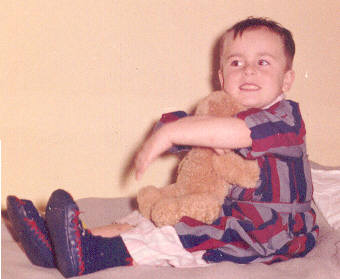 A week after Andrew died I received word
that Tom had Lymphoma. Tom, too, had schizophrenia, since he was in his early
teens. He was born in 1955. To put it mildly, he had a difficult life after his
illness. However, in his latter years he was quite stable, possibly due to a
new medication. He lived in a group home North of Toronto for about five of his
last years.
A week after Andrew died I received word
that Tom had Lymphoma. Tom, too, had schizophrenia, since he was in his early
teens. He was born in 1955. To put it mildly, he had a difficult life after his
illness. However, in his latter years he was quite stable, possibly due to a
new medication. He lived in a group home North of Toronto for about five of his
last years.
Then he developed cancer.
This is a photo of Tom at about 3 years of age
Before Christmas, 2003, Tom appeared to be recovering. Fortunately, he had very few side effects from the chemo therapy, other than losing his hair. However, the disease re-appeared. Tom underwent a series of tests to determine the extent of the re-occurrence and suitable treatment. We could only hope!
Tom died June 23, 2005. His non-Hodgkins lymphoma came back. He had some further treatments and it looked like he was recovering inasmuch as the obvious lumps on his neck, etc. had disappeared. All of a sudden he passed out at the place where he was staying, north of Toronto. They rushed him to the hospital but he died several hours later. He came down with a massive infection. With his weakened state because of the chemo-therapy, his immune system was insufficient to fight it off.
I sent the following email to Lyn and my other "healthy" children, Kim and Kathryn, after they heard about the situation and were concerned about my well-being.
Hi Lyn,
I went through several states of grief many years ago, both with Tom and with Andy. It was very difficult for me to accept the fact that first Tom and then Andrew would never again be normal. I had so many hopes and dreams. I still treasure the early times. For years I kept trying to make a difference by offering suggestions to them, etc. The tide turned one time when I drove all the way to a mental institution. near St. Thomas (past London) to see Tommy. He had been sent to the hospital in Penatanguishene for the Criminally Mentally Ill because they have an "open door" policy in the regular mental hospitals and he kept running away. Penetangue was a horrible place. I had to appeal to the Ontario Ombudsman to get him out and the only other hospital with locked doors was at St. Thomas. When I saw him I offered some suggestion about what Tom might do. He immediately got up and left. After driving for 2 1/2 hours I had about two minutes with him and then had to drive another 2 1/2 hours back to Toronto. I had plenty of time to think. I learned, the hard way, that I had to do what I could but accept the situation for what it was - with no likelihood or hope of its changing for the better. I learned just to be with Tom and Andy when I visited. Talk was not really necessary and didn't really help. Emanations of un-spoken love did. And it helped both them and me.
It might sound cold and unfeeling to say that I don't feel much grief at his death. I was sad but more for the unrealized promise than for the death of Tom and the previous one of Andrew, although that finality will pile another rock or two on a pile that was built rather high many years ago. At least the pile will not grow any more. But neither will it go away in a hurry, if at all. We all want to live a full life but a full life can include not only happiness but tragedy. We can and should take as much delight as possible from the happy times and we have the unwelcome opportunity to grow from the tragic ones. This is a difficult period for anyone. Let's continue to support each other and keep our spirits up, while we send our love to each other.
Love,
Dad
2005
Visit to Ireland
|
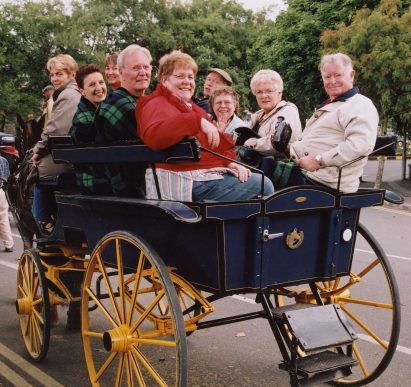
In September, 2005 I finally visited the land of my ancestors. Marion and I had the opportunity to experience what is known in Ireland as a Caeli (pronounced Kaylee. Marion volunteered me to participate in a contest wtih a song. (I won the prize!) If you'd like to see/hear my contribution, click here.
|
 |
2006
Unconventional burials
My brothers and I inherited several
patented mining claims near Kirkland Lake in Northern Ontario. It's a long
drive but the fishing is good and the quiet is intense. Our cabin is tiny but
we have the end of Beaverhouse Lake all to ourselves. I felt that the lake in
front of the cabin was a suitable place to deposit Andrew's and Tom's ashes.
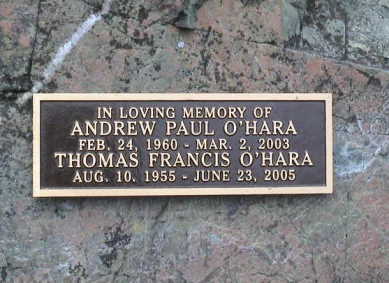 I didn't spread them but simply dropped the boxes into the water. So
they rest on the bottom, until the cardboard boxes disintigrate.
I didn't spread them but simply dropped the boxes into the water. So
they rest on the bottom, until the cardboard boxes disintigrate.
This year (2006) my brother Jack surprised me with a plaque dedicated to Andy and Tom. We installed it on a rock face below the cabin and facing the water. I was touched by Jack's thoughtfulness.
2006
European River Cruise
Marion and I have had some wonderful vacations. However, this year our vacation was particularly enjoyable.
In mid-October, 2006, we flew to Budapest and spent three days there walking and gawking, then boarded Amadeus Waterways' Amadagio for a two-week cruise from Budapest to Amsterdam via the Danube, the Mainz, and the Rhine rivers. After some 80 canal locks and 15 or so stops in mostly tiny medieval villages, as well as Vienna and Cologne, we disembarked in Amsterdam and spent three days there walking and gawking some more. We had fabulous weather on the cruise and left Europe just as a fierce rainstorm was moving in. The river cruise was great. The ships are small (to fit in the locks and under the many low-lying bridges). Ours had about 135 passengers and 50 staff (nautical, housekeeping, and hospitality). The atmosphere was excellent, the shore tours were very well planned and guided, and the food was excellent and beautifully presented with modest servings that made it possible to enjoy three or four courses without subsequent waddling or groaning. We enjoyed free local wines along the way (served with lunch and dinner).
With a
couple from the USA we put together a song to thank the crew on our last
evening on board. Fred (the American) and I did the crooning.
Click here to see/hear it.
2007
My 80th Birthday
This has been a rather special year. First of all, Marion planned and executed a marvellous party on the occasion of my attaining the "estimable" age of 80. We had a wonderful time with speeches, champagne, great food and the opportunity to entertain my brothers and their wives as well as cousins from Ottawa and Quebec City, my children Kathryn and Kim plus Lyn from Sedona, AZ and a number of friends.
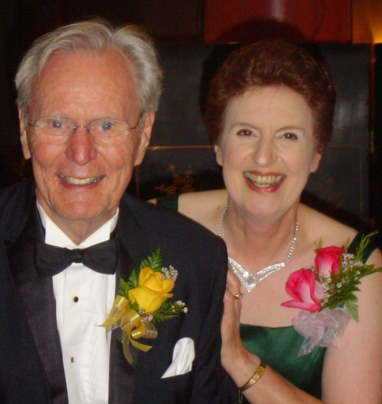 Frank & Marion |
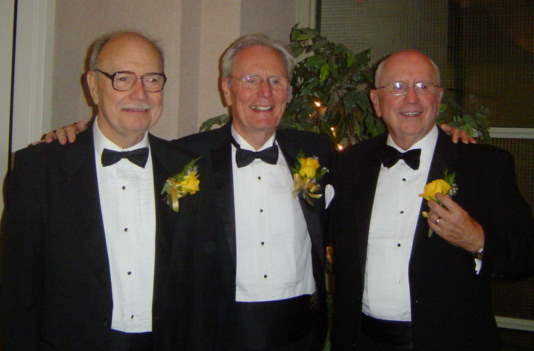 The brothers: Jack, Frank, Gerry |
2010
Tour France
 |
Marion and I have visited France quite a number of times. This year (2010) we decided to spend six weeks to visit some of the places we had not yet experienced as well as parts of Belgium. Top of the list were the sites of Canadian participation in World War I. |
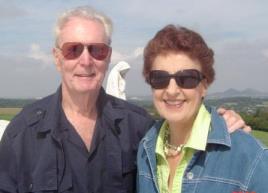 |
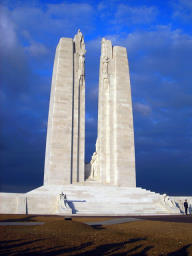
We rented a car from the Paris airport and drove north to Ypres in Belgium. (Driving in France and Belgium is a story in itself.) Ypres was decimated by WW1. Amazingly, they rebuilt all the medieval city exactly as it had been before the destruction. We used Ypres as a launching pad to visit many sites in southern Belgium and Northern France, including the famous monument at Vimy, that you see in the photo above.
Subsequently we spent several days in Bruges, a wonderfully preserved medieval city in Northern Belgium. Then we went south to such places as Giverny (Monet's house), Lyon La Forêt, Rouen, Honfleur, the Bayeux Tapestry, Mt. St. MIchel, Tours, Clermont-Ferrand, Nimes, Avignon, Lyon, Dijon and, finally, five days in Paris to visit a few places we had missed in previous trips, such as the sewars and the catacombs and several of the more obscure churches. Of course, we enjoyed the wonderful French cuisine, to say nothing of the wine and the cheeses and I had numerous opportunities to practice my French vocabulary.
I shot a lot of video so we can re-live this wonderful vacation many times.
2010
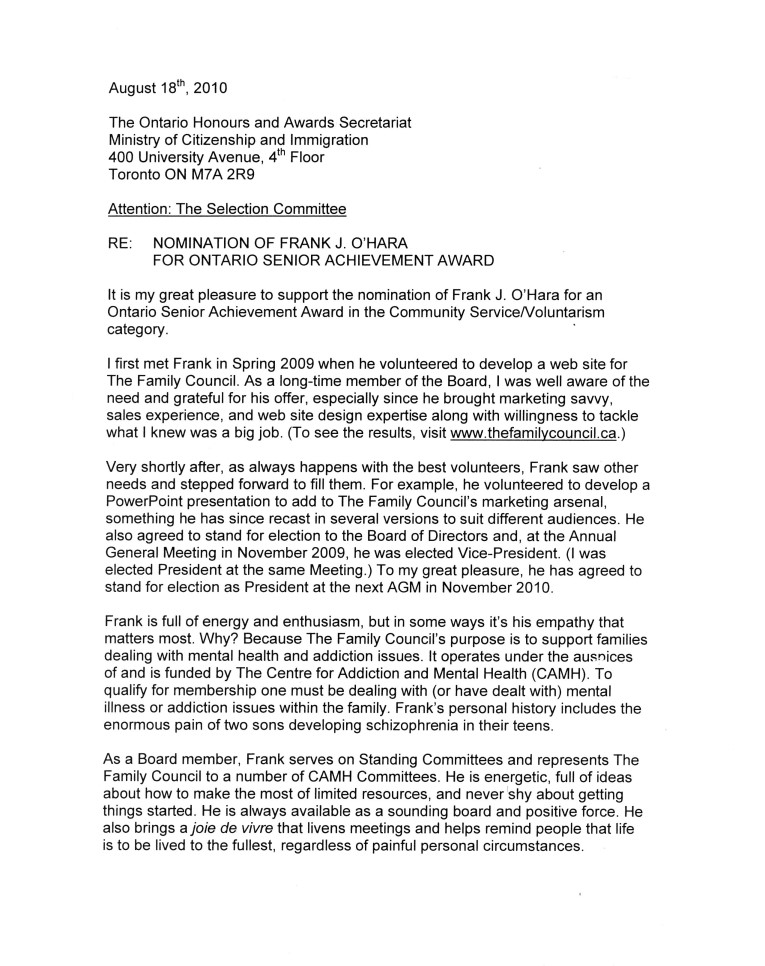
ONTARIO SENIOR ACHIEVEMENT AWARD
|
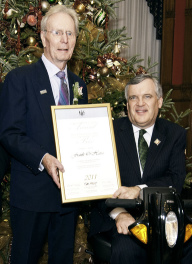
My wife, Marion, unbeknownst to me, nominated me for this Province of Ontario Award. Nineteen such Awards were conferred to recipients from across the province. I was the only one from Toronto. You can check out, below, the documents that Marion submitted. (They needed to be submitted a year in advance.) I received the Award from the Lieutenant Governor in a ceremony at Queen's Park December 14, 2011. Covering letter (read this first for an overview) Letters of support: OCAD University (page 1) (page 2) |
Frank
O'Hara |
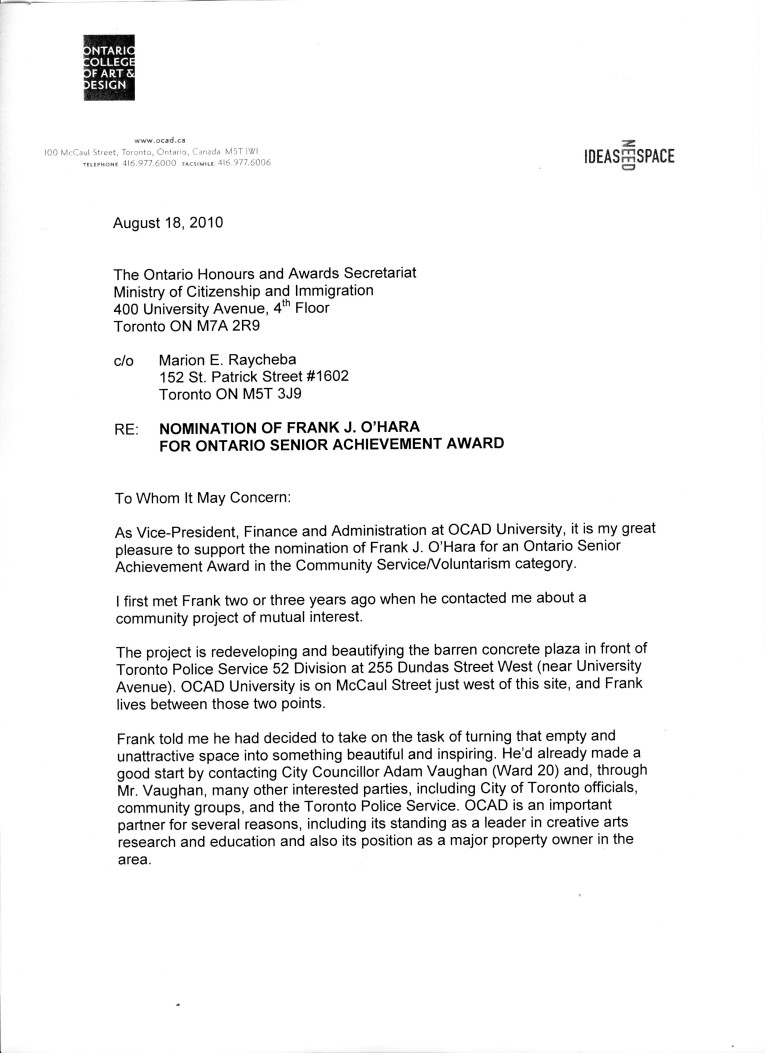
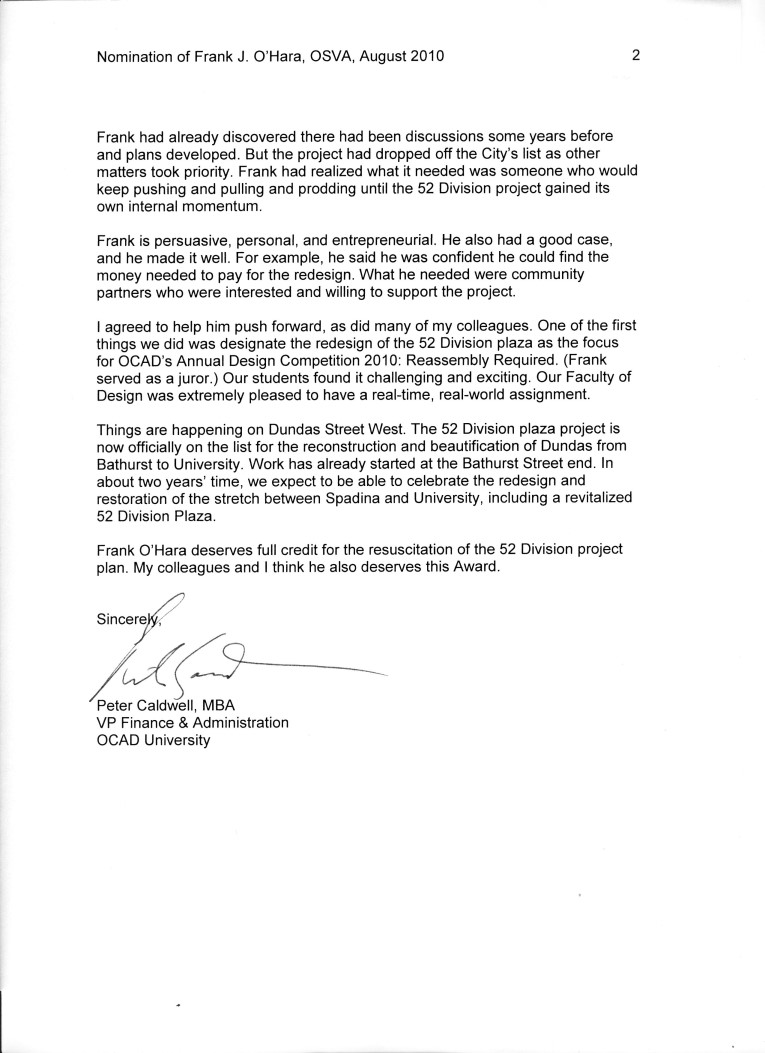
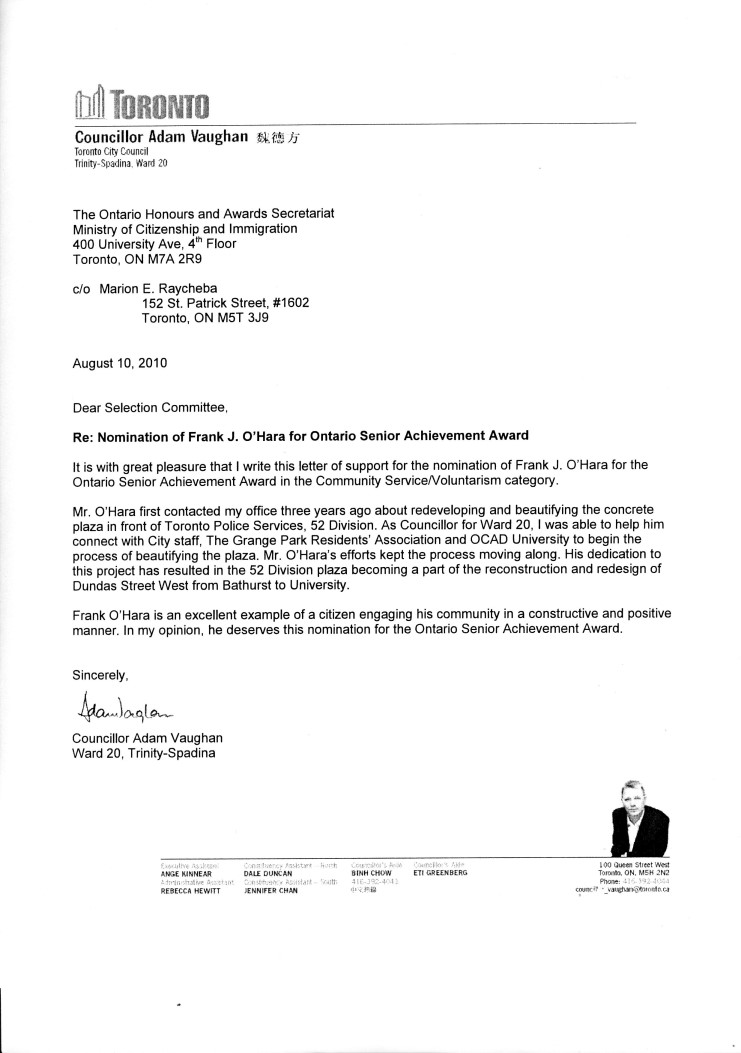
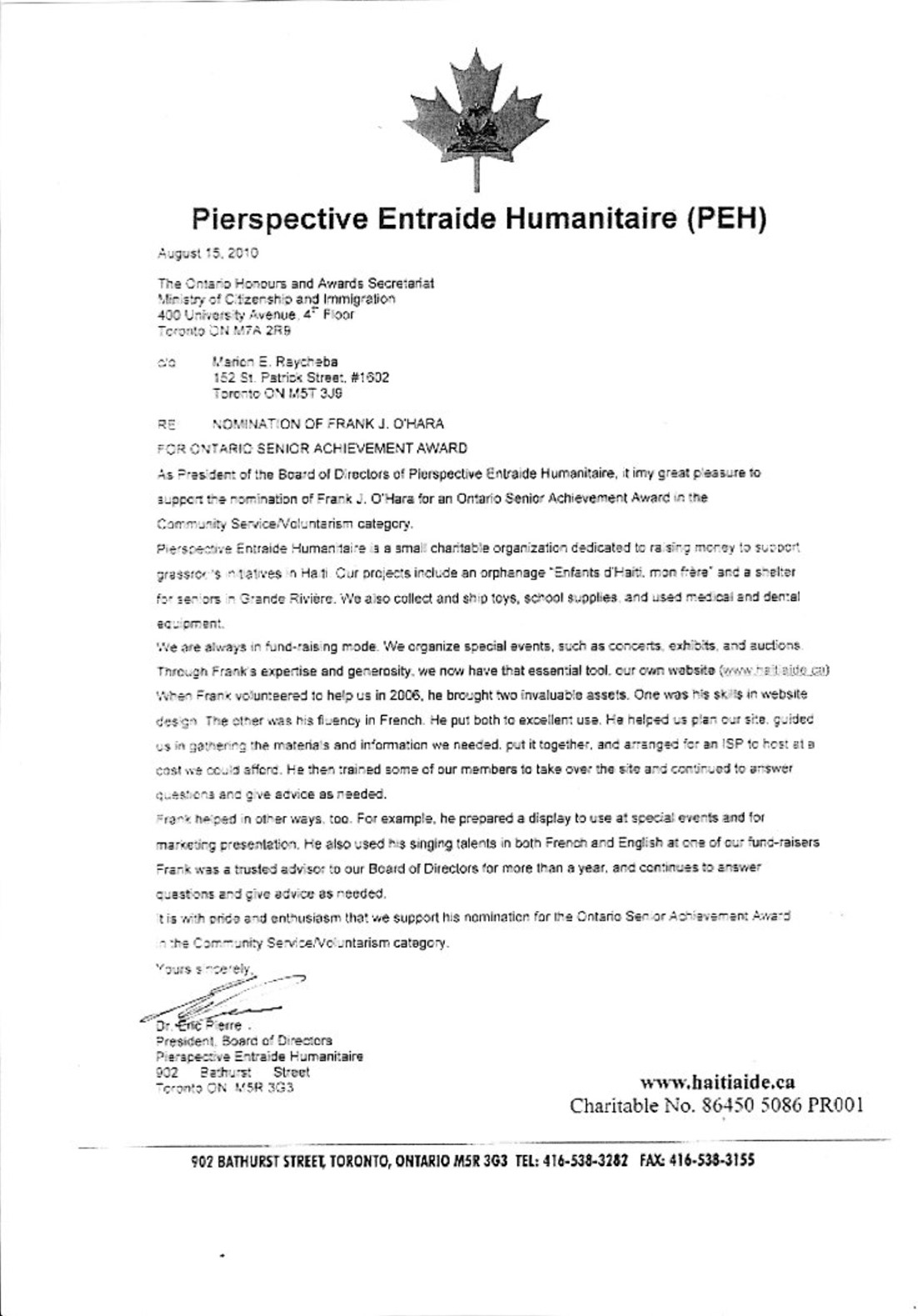
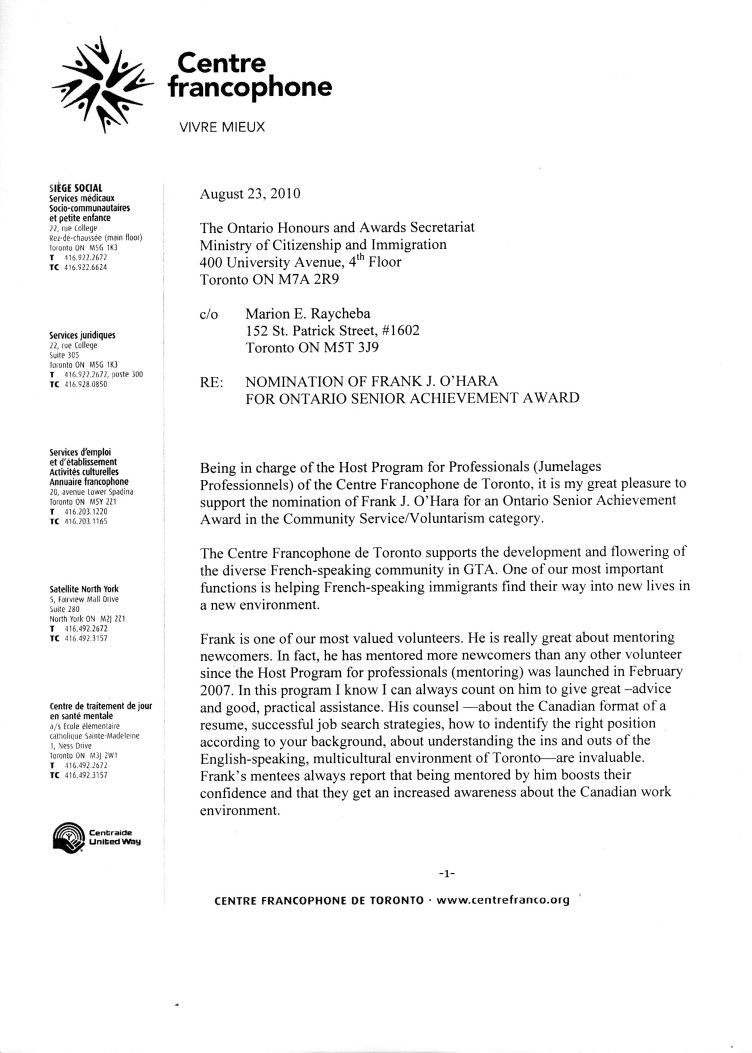
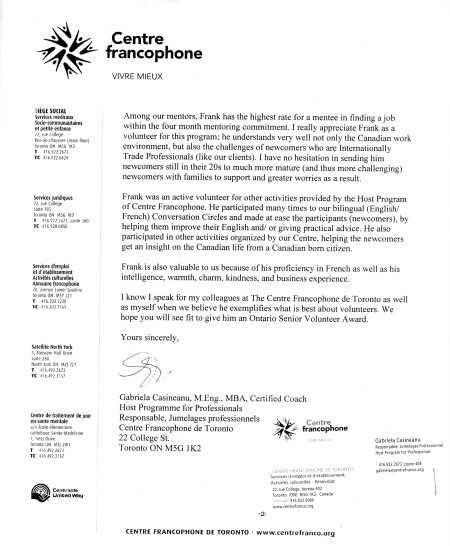
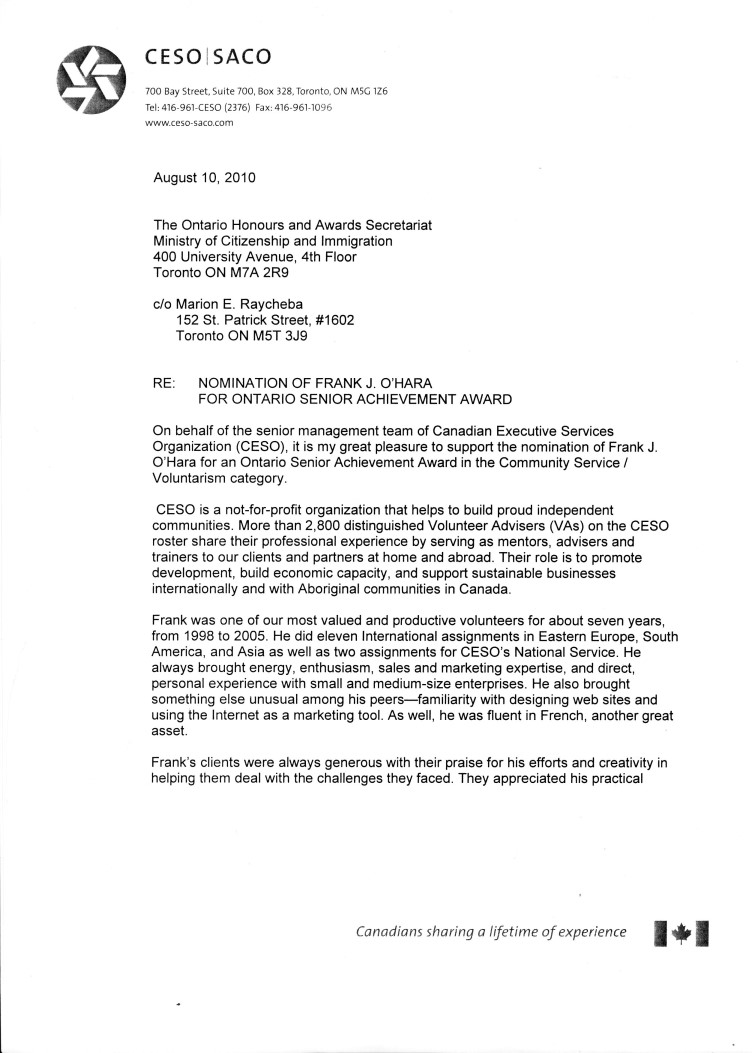
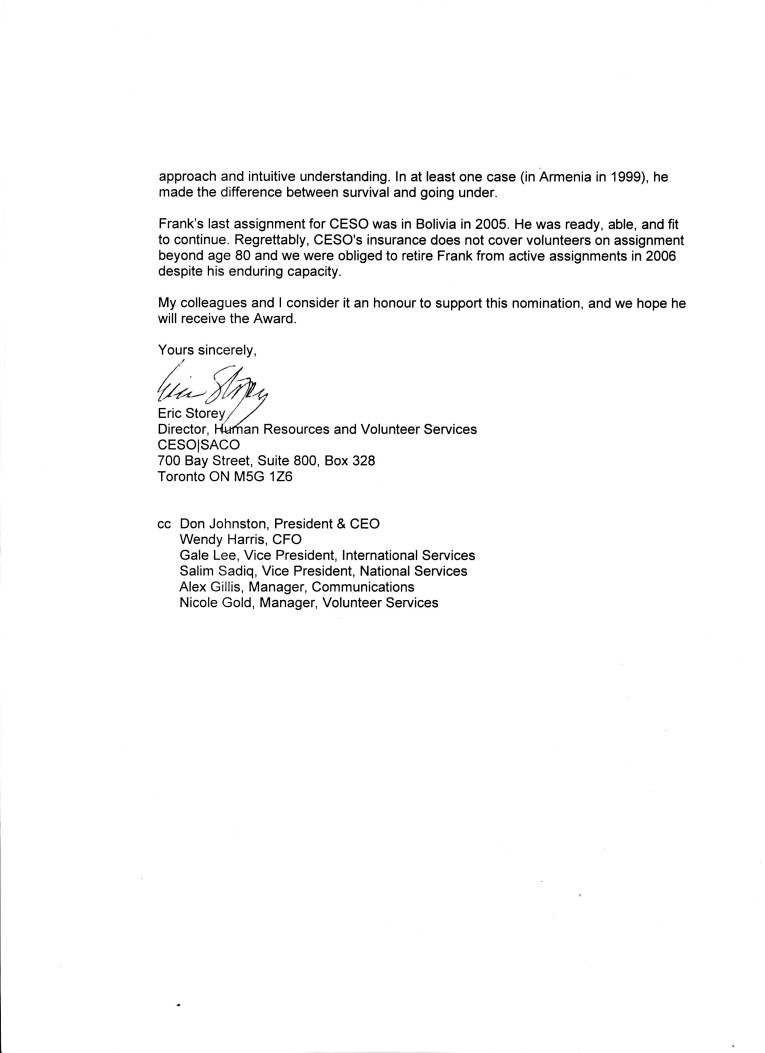
Canada Day Celebration July 1, 2012
Each year we celebrate Canada day with a potluck party at our place with friends from other countries. It's great tasting delicacies from China and South Africa. Marion and I provide a very Canadian ice cream cake.
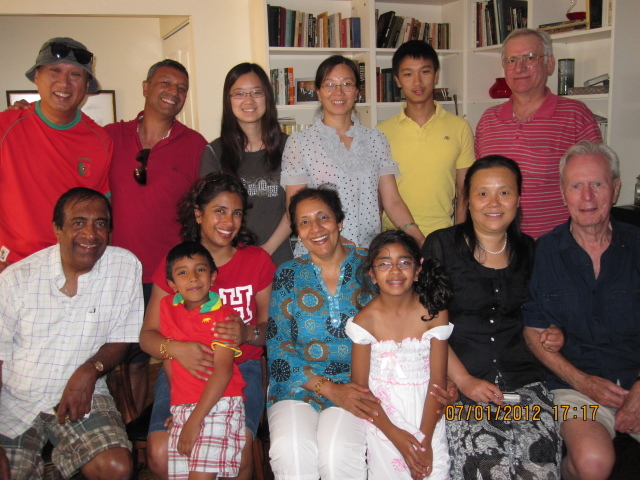
Front row (L to R): Ranjit Chouhan, Kellen Vallabh, Joti Vallabh, Saras Chouhan, Hailey Vallabh, Flora Wang, Frank O’Hara.
Back row (L to R): George Leung, Raj Vallabh, Jessie Wang, Aimin Qiu, Shiping Shen, John Raycheba
This year Jackie and Ray Liu and their children Max and Thomas were on vacation in Florida. Also, Flora Wang's husband Jun He and her son Yichen were in China.
Marion, as photographer, was not in the picture. Next year I promise not to be so egotistical.
2012
Queen's Diamond Jubilee Medal
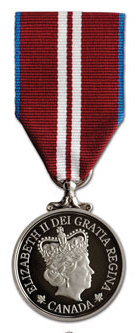 |
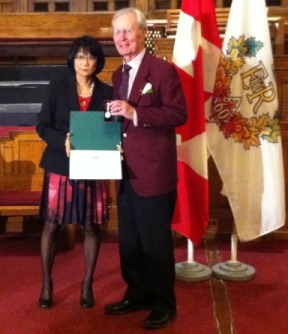
In honour of the Queen's 60th year on the throne, the Canadian government awarded a medal to 60,000 Canadians who have provided significant volunteer services to the community. My wife, Marion, fortunately for me, is my greatest booster. She submitted a recommendation for me to be awarded with such a medal. To see Marion's submission, click here: Submission for medal The woman presenting the medal is Olivia Chow, the Member of Parliament for our riding. A matter of passing interest is that the queen and I were born in the same month and the same year (April 1926)
|
 |
1948 to 2008
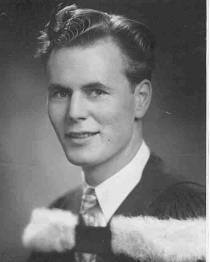
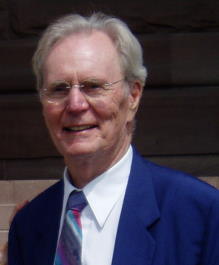
I took advantage of the government's re-establishment credits for ex-service personnel to go to university and graduated with a BA from the University of Toronto. Looking back, it is difficult to believe I was so "wet behind the ears". I didn't give much thought to what I might do as a career and there were no guidance counsellors in those days. I sure could have benefited from some advice. Well, eventually, things worked out not too badly but it took a number of jumps before I landed on my feet.
 1948 |
 |
 2008 |
2013
University of Toronto Spring Reunion
l2013.JPG)
|
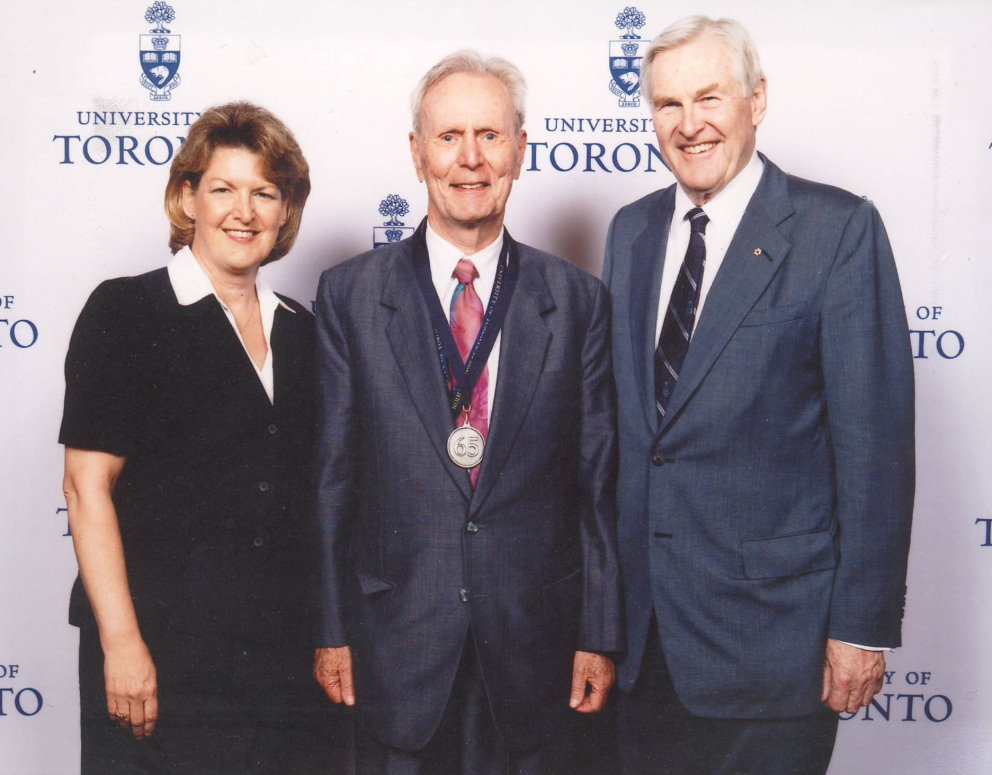
The 65th year of Frank's graduation (1948) from the University of Toronto. Lenna Bradburn,
President, University of Toronto Alumni Association |
2018
University of Toronto Spring Reunion
"Frank is 92 years of age"

|
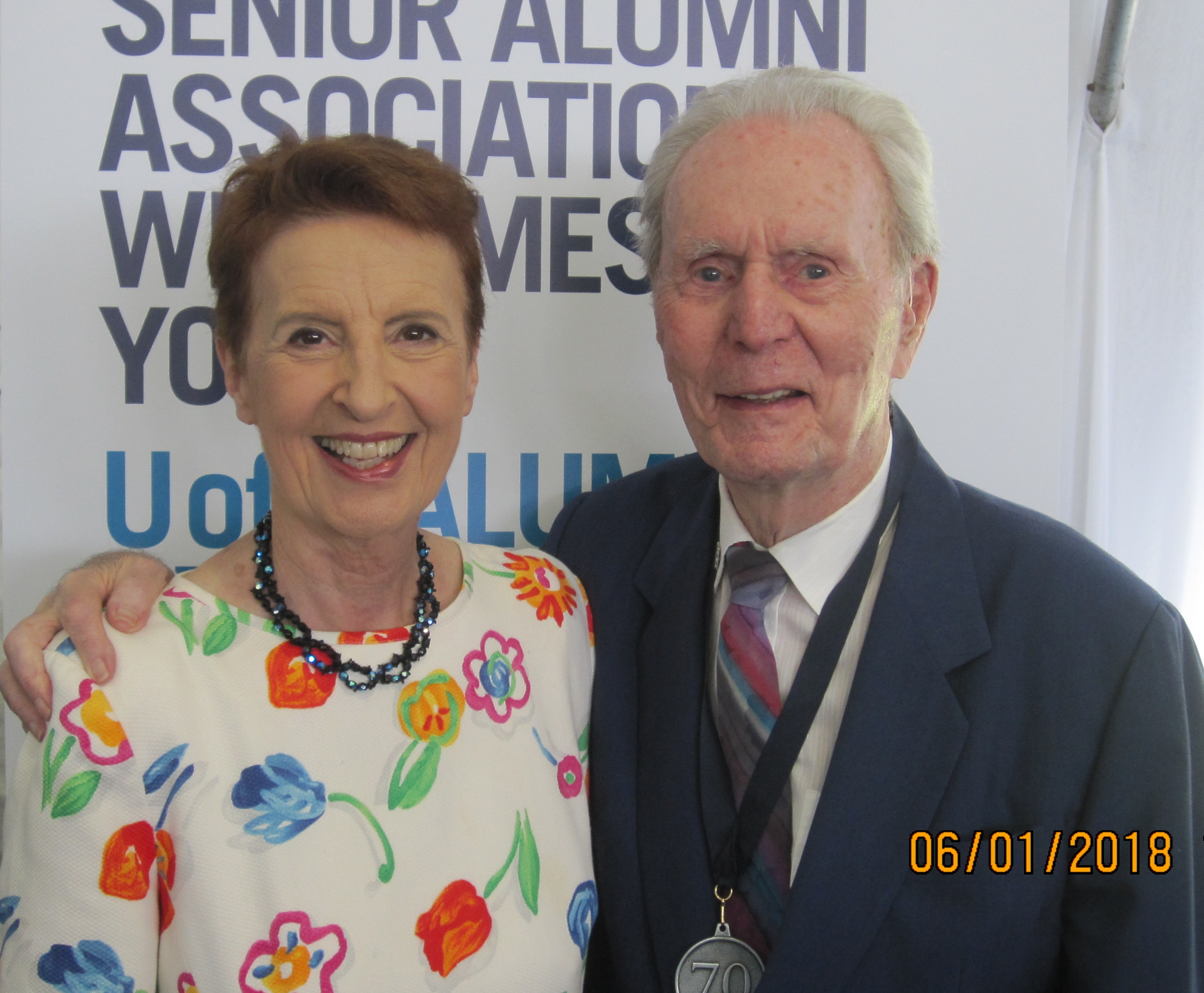
Frank & Marion The 70th year of Frank's graduation (1948) from the University of Toronto. |
2000 - 2017
What goes around comes around
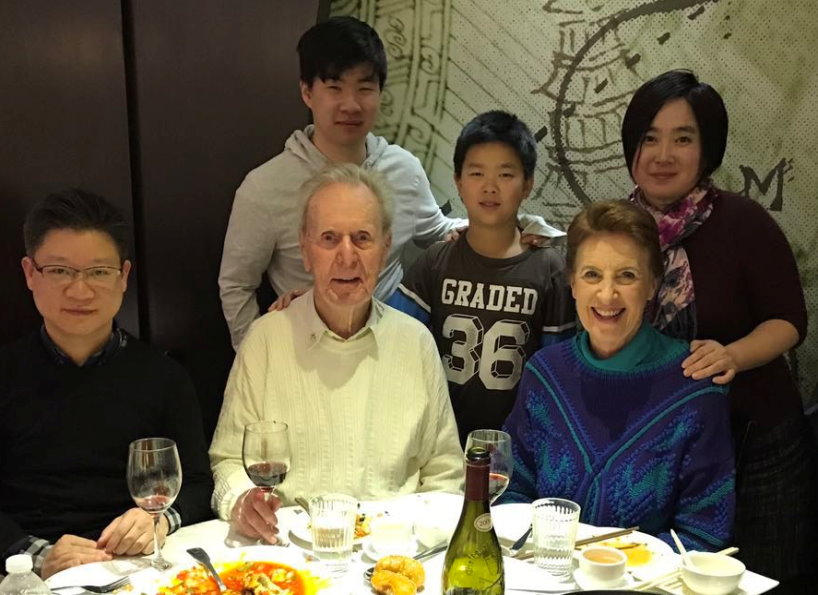
Front row: Ray, Frank & Marion - Back row: Max, Thomas & Jackie
Back about the year 2000, I bought a new chesterfield, however, I felt there was still some life left in the old, black leather one. Rather than throw it out or try to sell it, I asked the superintendent of my apartment building if he knew of someone who might find it useful. He suggested a young Chinese couple with a young son. They were new to Canada, had just moved in, and had very little furniture. I asked him if he would speak to them on my behalf.
Soon, a young man knocked at my door. He introduced himself as Ray Liu. Between the two of us, we managed to move the chesterfield to his apartment. There, he introduced me to his wife Jackie Zhou, their son Max (then just five years old), and his mother-in-law, who was helping them settle in. We had tea and talked. They told me they had been in Canada for six months and were finding it very difficult because they hadn't been able to find jobs. Their savings were running low, and they were seriously considering throwing in the towel. Both were accountants with excellent qualifications and experience. I thought I might be able to help them. And so our friendship began.
We met and talked many times. I helped them 'Canadianize' their résumés, suggest where they could send them, and so on. Since Ray mentioned he'd worked for the Bank of China, I recommended he apply to the Bank of China's head office here in Canada. His new résumé and ability to speak English got him a job as a teller. Soon, he was promoted and began managing the Bank's relationships with Canadian business clients.
I continued to lend a hand in the background, for example, helping Ray draft official Minutes in formal style and language (English) and giving my suggestions on dealing with clients. In the meantime, Marion, who had many years of personal and professional experience with The YMCA, was able to reassure Jackie about taking a temporary assignment (to cover a maternity leave) in The Y's head office. At the time, Jackie wasn't familiar with the concept of not-for-profits and was a bit concerned about both temporary assignments and the charitable sector. Would it be safe and secure? Would it add value to her job experience and résumé? It turned out to be the door opener she needed. Jackie ended up joining The Y's staff permanently for several years. She held increasingly responsible positions before moving to another senior position in the charitable sector.
We stayed in touch over the years and, from time to time, I was able to offer some advice about how to adjust to life in this new culture. Often, it was the little things that mystified. For example, Ray asked me about Christmas and Halloween. What should they do? I gave him a little history lesson about the links between these celebrations and ancient religions and how now for many Canadians they were purely secular but still important for the community as a whole.
Within a couple of years, Jackie and Ray bought a house in Toronto east end right across the street from a public school. As they settled in, they discovered other things, for example, how to talk to teachers and principals and how to move Max to the Gifted class where he so clearly needed to be.
Jackie and Ray have done extremely well since. They both earned Canadian CGI certification. Subsequently, Ray was head-hunted for a senior position with a Taiwanese Bank establishing a Canadian operation and, later as President of a large Chinese company's North American operations. Meanwhile, Jackie earned a senior position as the comptroller with a not-for-profit in Mississauga. They own a beautiful house, also in Mississauga. Max is attending McMaster University, and Thomas, who was born in Canada, is now on the cusp of his teens.
Max and I still meet periodically for what we call a "Chess Day". I used to level our contest by removing a few of my pieces. Those days are long gone. Now it's an even, and tough, match. We also have lunch and Marion joins in for a game or two of Scrabble. The three of us spend a wonderful several hours catching up and enjoying our friendship. Each year, around Christmas time, Ray, Jackie, Max, and Thomas treat Marion and me to a wonderful dinner at one of Toronto's best Chinese restaurants. Hence the photo above.
Just think! An old chesterfield led to all that
Why I continue to enhance my facility with French
Way back in 1965 I was in a serious car accident in Mexico. I had been travelling with my family through the USA and across the desert to Phoenix, Arizona, down the west coast of Mexico and across Mexico to Mexico City. All the time I was careful to wear a seat belt. I didn't bother to do it up, though, after stopping for directions to a famous archeological site just outside Mexico City. I was only five minutes away. A fateful five minutes. We had a head-on collision with a very large dump truck. My chest bent the steering wheel about 30 degrees and I shattered the windshield with my head. I guess it pays to be head strong. I survived, obviously. After several days in a jail-type hospital (Napoleonic Code: guilty until proven innocent) a young intern came to my bed. When he found that I was not a Gringo but a Canadian he said, "Mais je parle français beaucoup mieux que je parle anglais." (For the unilingual: "But I speak French much better than English.")
As a typical English speaking Canadian I did not have a working command of French. Lying on my bed of pain, with not much to occupy my mind, I decided, since I thought of myself as a "citizen of the world" I ought to be able to speak at least two languages. Being a Canadian, the two languages certainly ought to be English and French.
 If
nothing else I'm persistent. I've been working at becoming bilingual for all
these years since. I've made progress, particularly since I retired. I have
belonged to several different groups where I can work on improving my French.
If
nothing else I'm persistent. I've been working at becoming bilingual for all
these years since. I've made progress, particularly since I retired. I have
belonged to several different groups where I can work on improving my French.
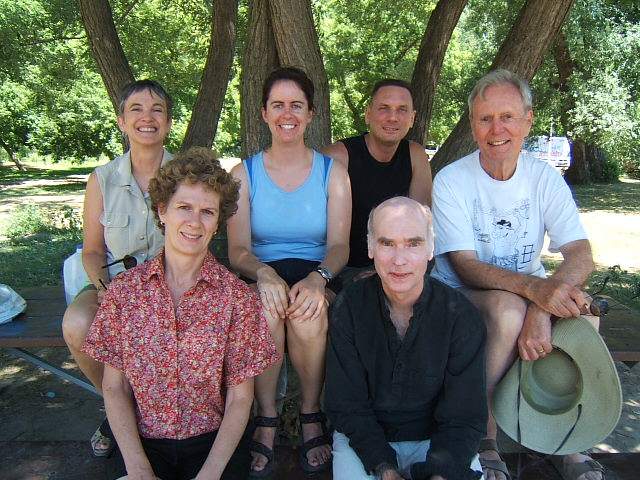
The Franco Flaneursmet once a month at one another's home for a pot-luck Sunday brunch. I was old enough to be the father of most of these fellow francophiles. It's interesting how a common interest can bring people together. Age is not necessarily important. Certainly that's true as far as I'm concerned and I believe that's the case with the other Franco Flaneurs as well. In the summer we've often gone on a bicycle/picnic sojourn. Here's a photo from one of our outings.
I
belonged to Le Centre Francophone de Toronto. They have various
activities organized around helping recent Francophone immigrants to Toronto. I
mentored immigrants from francophone countries, helping them to prepare a good
résumé and providing pointers on job-searching in Toronto such as
Central Library facilities, relevant websites, coaching for interviews, helping
with their English, etc. The fellow with me here is Leki Ymele, orginally from
Cameroon. 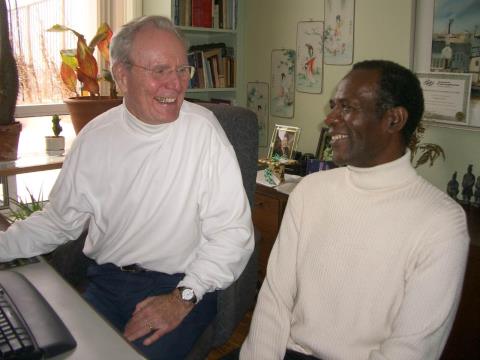
Twice a month I met with a group at the Royal Ontario Museum. We visited one or another exhibit in the museum and took turns leading a discussion on the content .Then we adjourn to a room where we took turns reading from information on whatever we've viewed and discuss new vocabulary. Some of my cotributions have been: The Parthenon, Japanese Samurai, The Byzentine Empire, and Daoism.
I also met each Friday afternoon for two hours at the First Unitarion Congregation. We take turns reading out loud a couple of paragraphs from an article from a current French magazine and then discuss what we have read.
I haven't acquired as much French as one might expect, after all these years. However, it is enjoyable to associate with others of a similar mind. Also, quite possibly, we anglos are better Canadian citizens for all our efforts.
My evolving Parkinson's Disease has forced me to cut back on such activitees.
Poverty, etc
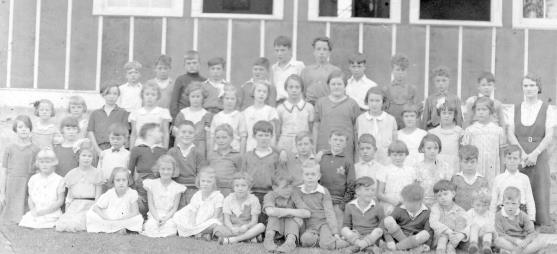
I'm in the centre of the first line, next to the
boy looking to his left
One teacher!! on the right
We were poor, certainly by today's standards. However, until recently, I never actually thought of our family as poverty stricken. Actually, that was normal in the "dirty thirties". In this photo I was in grade 2 but, obviously the teacher had a lot on her hands. (I'm in the middle of the front row, with blond hair and a big white collar and tall for my age.) Later, though, when we were each given a half pint of milk each day, I realized that some of my school mates usually didn't have breakfast. Our family was never quite that desperate but my parents had a serious and difficult job feeding and clothing four fast-growing boys.
My earliest memories were in a town called Swastika (named after the symbol for good luck). Dad had a general store - one of the two in the town. When the depression hit in 1929, dad was able to carry on for a couple of years. However, he couldn't bring himself to deny credit to families with young children. The desperate families were not to blame for dad's not being able to pay his suppliers. Those were desperate and evil times. The other store didn't grant credit and survived.
It was common for stores to grant credit because very few had cash for children's shoes, food, etc. Pay day was not a happy occasion. The rent came first. There was never enough to pay for all the other debts. I vividly remember my mother crying every payday.
Dad managed to get a job working underground in the Lake Shore Mine in Kirkland Lake, about 5 miles away. The mine ran 3 shifts a day, 6 days a week. Dad road a bike to work. Not too bad for the daytime ride - in the summer. The winter and the night were something else. I recall him crediting our prayers for not getting soaked in a storm. He claimed that it rained all around him. Later, we moved to Kirkland Lake. Dad could now walk to work. After a couple of years he managed to get moved to work on the surface where they framed the timber supports for the underground tunnels. Much less dangerous too. At school we would often feel the shudder of what was called a rock burst - a cave-in. Often this was just an area that was no longer being worked. But those of us with fathers at work underground had our own internal shudder.
When I was about nine or ten years old my brother Brian (two years younger) and I scrounged whatever money we could uncover to help the family. One job was to go through garbage to find six and eleven quart baskets that we could sell at the Saturday market. We got 3 cents for the smaller and 5 cents for the larger baskets. Women shopping at the market had to buy a basket because the farmers didn't provide any shopping bags. I graduated from that job to selling chickens. Farmers who sold eggs would often have one or two hens that were no longer laying eggs. I rented a stall and bought the "old-timer" hens for something like 25 cents each. I offered these at $2 but never expected to get that much. I learned to haggle from the Eastern European women who were real experts. They would fatten up the hens in the backyard.
One day a woman actually agreed to pay $2.Nnot an Eastern European obviously. I was delighted and I'm sure had a big smile on my face as I handed her the live hen, upside down with legs tied. "No, no", she said, "I don't want it live." I'd never even been on a farm let alone killed a chicken but for $1.75 profit I was sure ready to learn. I borrowed an axe, took the hen outside, found a tree stump, spread the hen's neck out and swung the axe. I had done lots of wood chopping so the axe was not a problem. However, when the hen's head flew off in one direction and the body flopped all over the place in another I had a passing thought that I'd earned my profit. My first entrepreneurial exercise but not my last and never so bloody or so shocking.
The forest was not far outside Kirkland Lake; so it was not a particularly big job for Brian and myself to fetch the family Christmas tree. It was hard tramping through the snow though. We brought back two at once; so we could sell the second one to a neighbour. We learned that trees that look a normal size in the bush are far too big after the struggle to get them home.
The most regular job I had was as a Globe and Mail paper boy. The paper left Toronto around midnight to arrive at Kirkland Lake about 1 PM the next day. I picked up my papers at that time and delivered quite a few of them at a fast trot on the way to school, for 1:30. The rest I delivered after school. Delivering newspapers in Northern Ontario in the winter, to use an inapt phrase, is no picnic. First of all it is pitch dark after about 3 in the afternoon, secondly there are some fierce storms, thirdly freezing temperature is the norm. I remember coming home covered with snow and the comfort of mother making me a cup of cocoa as I warmed myself in front of the wood stove in the kitchen.
However, it wasn't all hard times, besides, I never had anything to compare against; so I never felt hard done by. Needless to say, we didn't have a cottage. However, mother took us four boys camping when my brother Gerry (the youngest) was still in diapers. We had two prospector type tents. My uncle Tommy had a car and drove us out to one or another of the many lakes in the region where we stayed for most of the summer. Dad visited us most weekends on his Sunday off. (He worked six days a week for 13 years at the mine and never had a vacation. They went on strike for one week's vacation and lost the strike.) We cooked on an open fire, fished and picked berries and practically lived off the land. After that apprenticeship, when I was about 12 and Brian two years younger, we camped on our own for a couple of years, hitch-hiking in to town each Saturday so we could go to Mass on Sunday and then hitch-hiking back with provisions for the next week. I didn't realize till much later that this was probably our parents' innovative way to prevent us from getting into trouble with some of the other young people in our neighbourhood. When I think of the protective attitude of typical parents today I wonder at the difference and suspect that we learned a lot about self-reliance.
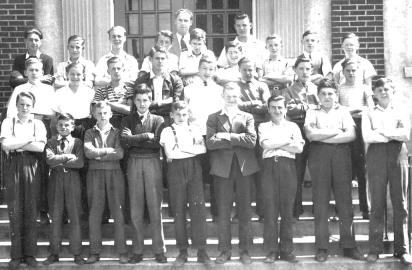
This is my grade nine class in Kirkland Lake, 1939. That's me, age 14, in the back row - three from the left, to the right of the teacher. I had now graduated from paper boy to working part-time, first at Kresge's and then at the local A&P Store. My wages were a wonderful 24 cents an hour. However, in those days a good-sized chocolate bar was 5 cents.
At the end of my next school year, dad had lost the strike at the mine (a struggle for one week's paid annual vacation) and travelled south to find a different job. He went to Welland, Ontario where he found work as a carpenter. WW II was in mid-stride and that put an end to the Depression. That year, 1942, I turned 16. The family was still in Kirkland Lake. I joined dad for the summer on a construction site as a labourer. The only problem was that when it rained, we had to sit it out and didn't get paid. It rained frequently. After a whole summer's labour, at the sumptuous rate of 50 cents an hour, having paid for my board and room and my train fare back and forth I only had enough money to buy myself a $35 suit. Suits were de rigeur in those days. That was my second one. I bought my first with the money from a Globe and Mail subscription contest I won two years before. Actually, from the time I was about nine or ten years of age I bought most of my own clothes. I also paid for such things as dental work. A filling cost $1 in those days plus $1 if freezing were required. I couldn't afford the freezing. I guess that helped form my life-long habit of being careful with money and early practice with making difficult (even painful) decisions.
We were poor but we children did have a number of advantages. We had parents who really loved and cared for us and set a good example of honesty, kindness and responsibility. My parents, as far as I can recall, never used the word "love" but they showed it in their daily lives both for each other and for us children. Mother was careful to provide us a balanced diet, even if it was with the cheapest cuts of meat and a limited assortment of vegetables. I recall asking the butcher for a bone for the dog. I'm sure the kind man knew that there would be no meat left for the dog. We grew up healthy in body and spirit and learned how to "stand on our own feet". I am grateful.
Why I Am Not a Christian or a Buddhist or a Muslim, etc.
When I was about 11 years of age I overheard a conversation between my mother and the priest who supervised the altar boys. I was one of his "stars". They were discussing how I would become a priest. I interrupted them to say, "But I'm not going to be a priest."
"Why not." my mother said, "Because I want to have children." I answered. They both laughed. "What's so funny?" I thought.
In retrospect, that was probably an indication of my not wanting to live by other's expectations. Another factor in my very gradual evolution away from my religious upbringing was my curiosity. Even as a very young child exploring the nature around our home just outside a village in Northern Ontario I was fascinated by the frogs, birds, etc. When I learned to read I haunted the public library in Kirkland Lake where we had moved. There was no money to buy books in those depression years, so the library's books were a great boon to my developing mind.
During secondary school years, my time in the navy and then at university I gradually questioned more and more of what I had accepted as "the truth". An analogy might be of a person held down by a thousand strings. Any one of them easy to break but all of them together quite capable of holding me firmly in place. It took a long time to break all the strings.
I found it difficult to accept everything on faith. Why this was the case I don't know. I remember discussing this with a priest, Fr. Sullivan, a much revered priest at St. Michael's College at the University of Toronto. "When you cross the street you have faith that you're going to reach the other side don't you?" He didn't find it a satisfactory answer when I replied, "Yes, but I avoid the traffic."
I well remember when I introduced my parents to, Austra, the woman I intended to marry. "But she's not a Catholic." mother blurted out. We got married in a Catholic chapel. Marrying a non-Catholic in a regular church was not permitted.
As a child I certainly accepted authority, whether of my parents, the church or professionals such as doctors or almost anyone older than I. When I was in the navy I felt, just because someone wore an officer's uniform didn't mean that he should hold power of life or death over me. Mind you, that didn't mean that I didn't avoid being sent to the brig. Gradually I arrived at the point where I questioned any authority before accepting it. Of course, that certainly doesn't mean that I think it is permissible to go against logical societal norms, like paying taxes, driving on the right side of the road or a thousand and one normal situations in daily life. I have a responsibility to support people with whom I agree and, at the very least, to avoid those with whom I disagree. For example, when it comes time for an election I investigate whom I should support and having decided do so, not just with my vote but by canvassing or whatever other means are at my disposal. A number of years ago, for example, I designed and produced a website for my federal MP and I canvassed on his behalf at each election.
My "belief system" involves doing what I reasonably can to make this world a better place. With that in mind I have volunteered to work in developing countries around the world. Mind you I also enjoyed travelling to exotic countries, meeting diverse people and helping them as best I could. I also believe it is important to do what I can here at home and volunteer to help newcomers to Toronto from francophone countries. Of course I benefit too with the opportunity to practice French. My wife, Marion, and I have also been able to help a couple of immigrant Chinese families. No improvement to our Mandarin, though. A percentage increase on zero is still zero!
It seems that most religious people find it difficult to impossible to believe that others could honestly not believe as they do. Christians in the later middle ages massacred 30% of the European population (30 Years War) on behalf of their "loving" God - the same one on each side! Militant Muslims believe non-believers, even non-believers of their particular sect of Muslim, should convert or die, just like the perpetrators of the Inquisition. Some militant Sikhs feel it is OK to blow up a plane full of innocent people. However, I don't reject religion because some aspects of it are evil. I just cannot bring myself to accept the basic tenets of any religion. I do have a sort of "faith" though. I believe the world is evolving in a positive and realistic direction. There are days I despair, such as with Global Warming. If we can deal with that, though, it could mean that we are on a path towards a world that doesn't need the crutch of religion and with which we can have a genuine hope for a world dominated by "goodwill towards man", to coin a phrase. This doesn't mean that I'm against organized religion. It does mean that I'm against any role for it in government.
My Politics
When I was in the Navy, aged 18, towards the end of WW II, I had my first occasion to vote. I believe I have never missed an opportunity since, either federally, provincially or municipally. I have, at one or another time, voted for each of the major parties. I have also canvassed many times for my preferred candidate in my constituency. So I guess I qualify as a serious supporter of our democracy, as well as being a "floating voter", the type of person whom each of the parties must attract. I cannot be taken for granted like those who are "dyed in the wool" supporters of a particular party. I have also, on occasion, interviewed the candidate I for whom I might support. When I lived in the Don Valley West riding, for example, I met with Liberal John Godfrey, when he first ran for Member of Parliament. I was sufficiently impressed that I volunteered to create a website for him. That was when websites were the exception rather than the rule. I also canvassed for him during several subsequent election campaigns. More recently, I worked for NDP MP Olivia Chow.
Some of My Concerns
- A good education is frequently lmited by
the wealth of parents. This is an out-of-date concept. A well-educated populace
is the way to ensure a prosperous society and a properly functioning democracy.
As such, I believe every Canadian should be able to complete an education as
far as his or her capabilities will carry. In WW II
we sent one million of our people overseas. That meant the removal of 1/4 of
our workforce of about 4 million (from a population of 11,267,000).
Nevertheless, for 5 years we produced ships, guns, planes, munitions, supplies,
paid our army, navy and airforce,etc.. After the war, we generously gave our
veterans free post-secondary education or alternatively, money to start a
business or assistance in building a home. Today, we supposedly, can't afford
to up-to-date infrastructure ($123 billion behind!) nor enough money to fully
support Medicare. Why do we have so many homeless people on our streets? Why do
we have the mentally ill and addicts begging on our streets and clogging our
prisons?
- Some countries provide free tuition as
far as a person's ability will carry one, among them Denmark, Ireland, France,
Germany, Spain, Sweden, Australia, and Cuba. In Canada, the federal government
provided this support for veterans of WW II. It's what made it possible for me
to go to university. It would have been extremely difficult, likely impossible,
for me to do so otherwise. I believe I was able to contribute a great deal more
as a result of having that education. Free post secondary education is the norm
for most European countries, even for foreigners. My daughter, Katherine, took
her second year of university in Paris. The young woman I met in Russia, at my
sugestion, went to Paris and earned her Master's degee, free!
- Children who don't get a good start in
life are unlikely to make up for it later. To assure a prosperous society, we
should provide Early Childhood Education as a matter of right. This
would not be a baby-sitting service but a means to prepare pre-school children
for a lifetime of learning. Well-trained specialist teachers are
essential.
- Every young person, probably at age 18 or
19, should spend a year or maybe two in community service. Those not qualified
by temperament or lack of education could spend their time in the military or
something comparable. During the service, the young people would be paid a
subsistence wage. Those attending post secondary education and with
satisfactory marks would be allowed to delay their service until leaving
post-secondary school. Possibly some, such as physicians, teachers, engineers,
etc, could do their community service in the our North or other under-served
areas in Canada or in Third World countries.
- According to Statistics Canada, the
richest fifth of Canadians' after-tax income grows substantially. The poorest
fifth of the population's earnings stagnate, as do those of the middle three
fifths over the same period. It seems we live in a "trickle-up"
society.
- In my opinion, we should not plan to
increase Canada's poplulation. Most of our land mass is uninhabitable and I
question whether our major cities should get much larger. For example, the
Greater Toronto area has a population of over 5 million. About 100,000 people
move here annually. What should we aspire to?
- A few Canada's First Nations peoples take
advantage of a post-secondary education (paid by the federal government) and
move up the ladder of economic success. But they are a tiny minority. There are
some 2,200 reserves across Canada. Most are in desbicable shape and are in
remote locations. Providing high quality Early Childhood Education plus support
for parents struggling with social conditions would, in my view, bring positive
change over time. What is clear is that continuing what we've been doing won't
accomplish any more in the future than it has in the past.
- Measuring our prosperity based on annual
GDP (gross domestic product) is inaccurate at best. Money spent on gambling,
golf club membership, cigarettes, liquor, and second or third homes, etc., are
not an accurate measure of our general well-being. In one of the richest
countries of the world over 2 million children live in poverty. GDP takes no
account of that.
- Criminal activities in Canada are reported
to net them multi billions of dollars per year. No income tax! This is one
possible reason to increase consumption (GST) taxes and to lower income taxes,
at least for the bottom 80%, accordingly.
- Cutting the GST (goods and services tax)
from 7% to 5% smacked more of American Republican influence than sound
economics.
- The Canadian Federation of Municipalities
estimates that the cost of maintaining, repairing and replacing Canada's
municipal infrastructures has reached $123 billion. The organization breaks
down this infrastructure deficit figure as: water and waste water systems $31
billion, transportation $21.7 billion, transit $22.8 billion, solid-waste
management $7.7 billion and community, recreational, cultural and social
infrastructure $40.2 billion. How long are we going to let this
grow?
- A study by the Tax Justice Network
concluded that tax havens around the world, from Switzerland to the Cayman
Islands, etc. are hoarding $44.8 trillion. Very rich Canadians park
$multi-millions in foreign tax havens. We need to track this money and tax it,
along with a fine.
- Addicts, as well as the mentally ill, need
to be treated, not incarcerated
- The owner of a business that I helped in Romania came to Toronto on a business trip. I was ashamed when he asked me "how it could be that there were no people pan-handling and sleeping on the streets in his city and so many of them living on the streets of Toronto. Yet the city of Toronto is obviouslly far richer." I didn't have a satisfactory answer. I'm still ashamed!
When we won't need human workers
I recall when I was a student working as a pick and shovel labourer. A group of us were leaning on our shovels when the straw boss came along and yelled at us. "Get back to work you #%^*s or that machine is going to do you out of a job." I thought, "What a good idea".
Seventy years ago John Kenneth Galbraith wrote The Affluent Society. He raised the basic statement: "For eons we supported the idle rich. Now we'll have to support the idle poor."
That's all for now folks!