Frank O'Hara & Marion Raycheba in Sri Lanka
May 17 - June 24, 2004
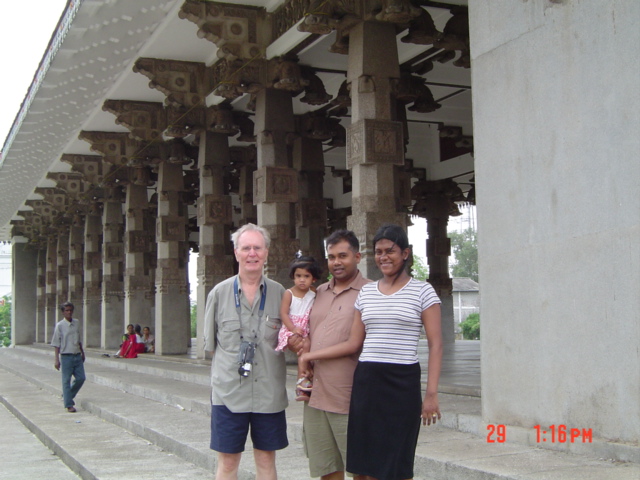
Frank with hosts Sampath & Lakmini Liyanage and their
daughter Ashwiniin front of Independence Hall commemorating
Sri Lanka's independence from Britain on February 3, 1948
Some things that surprised us:
Many people go barefoot; many men wear a skirt (sarong)
otherwise they wear Western clothes; almost all women wear long skirts and many
wear saris; eating with one's fingers is the norm, so food is served as a sort
of 'mush'; there is no word in Sinhala for "please"; Sri Lankans shake their
heads left to right, as if they are disagreeing with you, when they are
actually indicating their agreement. To us Sinhalese and Tamils are
indistinguishable in appearance; with very few sidewalks and crowds of
pedestrians we never saw a person hit by traffic; bus drivers own the road;
bribery, graft, and corruption are the norm; Buddhists seem to pay more
attention to their rituals than to their principles; people on the street
frequently give a wide welcoming smile to Europeans; in a world-wide contest
Sri Lankan food might well be judged the spiciest (hottest).
Our work
Sampath and his wife, Lakmini, run a small advertising agency,
Sansu Advertising Service, established by Sampath's father in 1982. I was the
official volunteer from CESO. Marion came along as my spouse. However, Marion
was as busy as I was and as important to the success of the assignment. I
worked on such things as planning several databases to help keep track of jobs,
do sales follow-ups, and determine which jobs made a profit. I also helped
develop a website for the company as well as one for a client and participated
in meetings with some clients and prospective employees (hiring one). In
general, my responsibility was to help management shift the business out of the
doldrums and into a successful and profitable enterprise. Marion also took on
various jobs, for example, preparing a template for making written campaign
(new business) proposals. Marion and I used this template to prepare an actual
proposal for a live prospect, and I prepared a PowerPoint presentation and
other sales props. Then, we worked as a team to coach Sampath and Lakmini on
how to actually present the proposal. Marion, being a true professional
words-smith, worked with the clients on a good many advertisements, brochures,
leaflets, sales letters, etc., to incorporate what "perfect" English copy looks
like. (Interestingly, although Sinhala is the main language (72% of the
population) and Tamil is common (about 12%) English is used extensively in
business and government and thus in corporate advertising.)
Our accommodation
Sansu Advertising Service is on the first floor of
a 7 storey hotel that the principals also own. The day we arrived, Sansu was
just moving into its new offices, so new that many windows still didn't have
glass and the office lacked a front door. We had a one-bedroom apartment on the
hotel's second floor, which was very convenient. Things were understandably
chaotic for a few days. Installing telephone lines, for example, is not a
simple exercise in developing countries. Plumbing and electrical work is done
by unlicensed people; so, standards are "different" from our expectations and
problems can be expected. However, in general, things worked out quite
well.
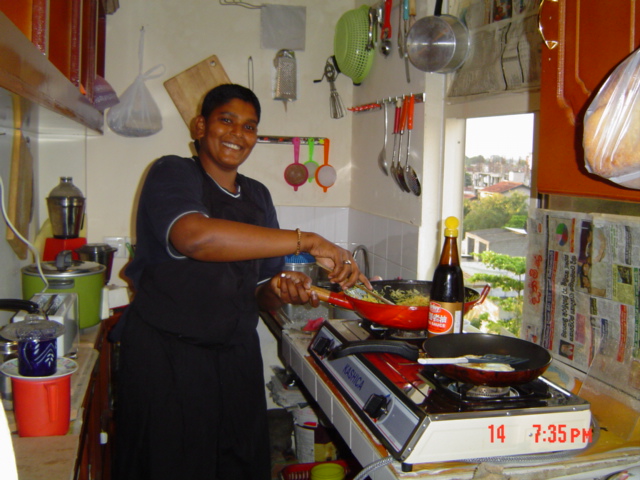 The top
floor of the hotel is open to the air. One half is designed for use as a
restaurant. (This space was being glassed in and air conditioned while we were
there, but the work was still in progress when we left.) This is a picture of
Sanju, the cook, at work. You will notice that everything is close at hand. At
first we took all our meals from Sanju. We learned that curry comes in many
flavours: hot, hotter, breath-taking, and sweat-producing (even for Sri
Lankans). Marion handles hot spices with the best of them. Once, to everyone's
astonishment, she ate calmly and with enjoyment something so hot even our
clients were sweating. I, on the other hand, have a mouth that burns at the
first hint of hot spices. Even when I requested absolutely no spices in the
food, I could just barely manage it. Also, there is little difference between
breakfast, lunch, and dinner. After a couple of weeks, and finding a grocery
store about 1/2 kms away, we prepared our own breakfast and lunch in our
apartment. The top
floor of the hotel is open to the air. One half is designed for use as a
restaurant. (This space was being glassed in and air conditioned while we were
there, but the work was still in progress when we left.) This is a picture of
Sanju, the cook, at work. You will notice that everything is close at hand. At
first we took all our meals from Sanju. We learned that curry comes in many
flavours: hot, hotter, breath-taking, and sweat-producing (even for Sri
Lankans). Marion handles hot spices with the best of them. Once, to everyone's
astonishment, she ate calmly and with enjoyment something so hot even our
clients were sweating. I, on the other hand, have a mouth that burns at the
first hint of hot spices. Even when I requested absolutely no spices in the
food, I could just barely manage it. Also, there is little difference between
breakfast, lunch, and dinner. After a couple of weeks, and finding a grocery
store about 1/2 kms away, we prepared our own breakfast and lunch in our
apartment.
We got so wrapped up in our assignment that we
worked very long and strange hours, including as early as 5:30 in the morning
and on Saturdays and Sundays. Of course, a 10-hour time difference from Toronto
meant that it took us a while to sort day from night. Our apartment had an
air-conditioner in both the living room and bedroom. This made it very
convenient and comfortable to work at any hour. Typical temperatures are in the
mid- to high 30s Celsius every day, with very high humidity. Because it was
monsoon season, there were also frequent, fierce sweeps of rain. I suppose a
person who is used to the Canadian climate would acclimatize in time. We found
it enervating.
Sight-seeing
For the first three weeks, we did not leave the
city of Colombo, although Sampath and Lakmini took us shopping and to see some
local sights.
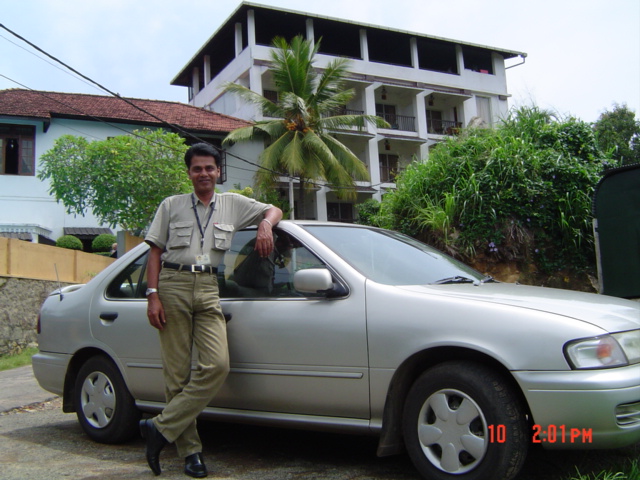 At the end of our fourth week, we took
Friday, Saturday, and Sunday off to visit Galle at the south end of the island.
We rented a car with a driver/guide to show us around. That's Hamid with our
hotel, The Lady Hill, in the background. It wasn't very busy, being off-season,
but even so we could see the tourist business is suffering as a result of the
conflict between the Sinhalese and Tamils. There were no problems while we were
in the country, but shortly after our return there was a bombing incident in
Colombo. At the end of our fourth week, we took
Friday, Saturday, and Sunday off to visit Galle at the south end of the island.
We rented a car with a driver/guide to show us around. That's Hamid with our
hotel, The Lady Hill, in the background. It wasn't very busy, being off-season,
but even so we could see the tourist business is suffering as a result of the
conflict between the Sinhalese and Tamils. There were no problems while we were
in the country, but shortly after our return there was a bombing incident in
Colombo.
Hamid, our guide, is a member of the Muslim
minority. He is of Malaysian ancestry and speaks Sinhala, Tamil, Arabic, Urdu,
Malay, and English. He worked for 20 years in Dubai and saved the money to buy
this car and a house when he came back to Sri Lanka. The chance for the average
person to make and save significant sums in Sri Lanka is remote.
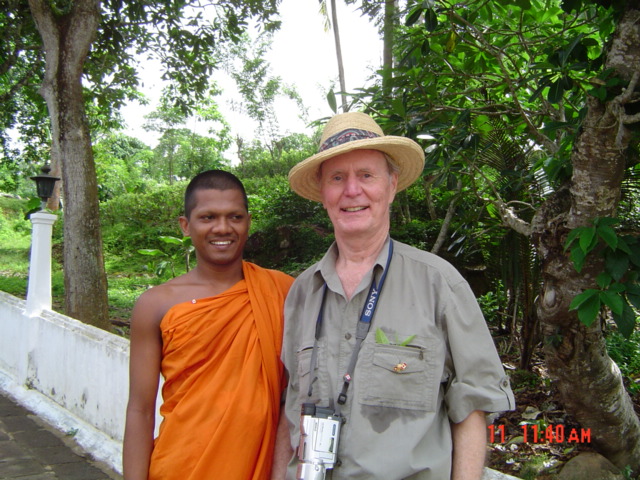 The
island is extremely verdant and has countless pristine beaches. Well off the
main road, we visited a jungle-surrounded ancient Buddhist temple. A 22 year
old monk was the sole attendant. With Hamid's help, we learned that the monk
entered a monastery when he was only seven years of age. He made a point of
saying that he volunteered, unlike many children who are volunteered by their
parents. If you look closely you will see a Canada flag pin on the edge of his
robe. He was as delighted as a small unspoiled child and insisted on giving me
a gift in return ("Manual of Buddhism" in English). I also gave him a ballpoint
pen (with my company name on it). I was pleased to meet this ingenuous and
pleasant fellow and to get to know him, however briefly. The
island is extremely verdant and has countless pristine beaches. Well off the
main road, we visited a jungle-surrounded ancient Buddhist temple. A 22 year
old monk was the sole attendant. With Hamid's help, we learned that the monk
entered a monastery when he was only seven years of age. He made a point of
saying that he volunteered, unlike many children who are volunteered by their
parents. If you look closely you will see a Canada flag pin on the edge of his
robe. He was as delighted as a small unspoiled child and insisted on giving me
a gift in return ("Manual of Buddhism" in English). I also gave him a ballpoint
pen (with my company name on it). I was pleased to meet this ingenuous and
pleasant fellow and to get to know him, however briefly.
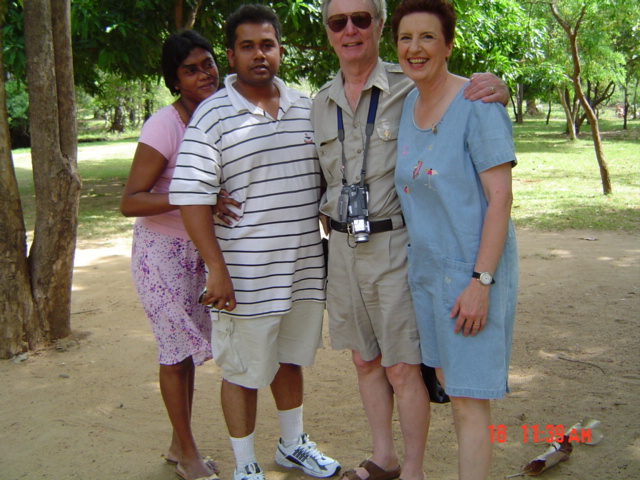 At
the end of our fifth and last week in Sri Lanka, we took another three-day
week-end to visit the Cultural Triangle with Sampath and Lakmini. This is in
the middle of the country where the ancient civilizations were located - going
back as far as 300 BCE. (The Sinhalese immigrated from northern India to escape
persecution because of their brand of Buddhism. They regard themselves as
guardians of the legitimate and original form of Buddhism, although there are
several varieties in the country.) At
the end of our fifth and last week in Sri Lanka, we took another three-day
week-end to visit the Cultural Triangle with Sampath and Lakmini. This is in
the middle of the country where the ancient civilizations were located - going
back as far as 300 BCE. (The Sinhalese immigrated from northern India to escape
persecution because of their brand of Buddhism. They regard themselves as
guardians of the legitimate and original form of Buddhism, although there are
several varieties in the country.)
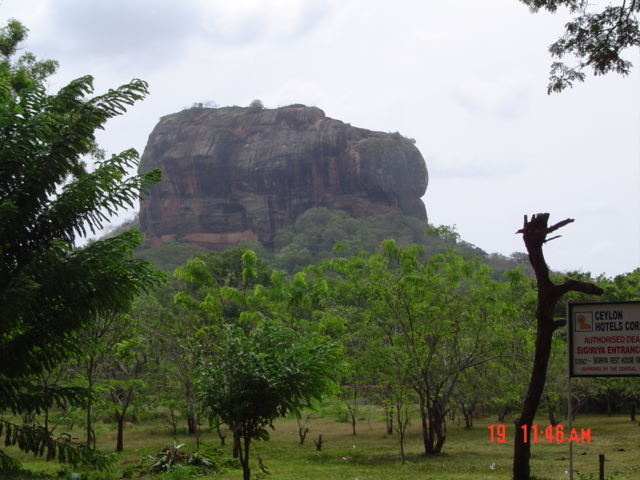 The island is just
about all jungle, complete with wild elephants and many other animals,
interspersed with paddy fields, small towns, and resorts. Some of the ancient
ruins are spectacular. There are three principal sites, each covering a good
many square kilometers. About 300 AD one of the king's sons killed his father
and fled to Sigiriya. It took nine years (and plenty of help) to build his
palace on top of the rock and the fortress walls with a moat around the base.
Inside the fortress, he built offices, homes, and facilities for his key
advisors and the nobility. This area, which is still being excavated, included
pools, fountains, baths, and gardens. I climbed to the top - 1042 steps and
lots of them very steep. Any phlegm I might have had in my lungs was certainly
dissipated by the effort. There is a great view from the top - once you wipe
the perspiration from your eyes. The island is just
about all jungle, complete with wild elephants and many other animals,
interspersed with paddy fields, small towns, and resorts. Some of the ancient
ruins are spectacular. There are three principal sites, each covering a good
many square kilometers. About 300 AD one of the king's sons killed his father
and fled to Sigiriya. It took nine years (and plenty of help) to build his
palace on top of the rock and the fortress walls with a moat around the base.
Inside the fortress, he built offices, homes, and facilities for his key
advisors and the nobility. This area, which is still being excavated, included
pools, fountains, baths, and gardens. I climbed to the top - 1042 steps and
lots of them very steep. Any phlegm I might have had in my lungs was certainly
dissipated by the effort. There is a great view from the top - once you wipe
the perspiration from your eyes.
In many places throughout the Cultural Triangle
there are what looks like small lakes. Actually, they are giant water
reservoirs, called tanks, built by the ancient kings. The central area gets
more than enough rain during monsoon season but little otherwise. So, the
kings, with great foresight, constructed the reservoirs to collect the water
for irrigating the paddies during the dry season. The tanks are still used for
irrigation some 2000 years' later!
A bit of history
The Tamils came to Sri Lanka about 300 CE. The
first traders to visit Sri Lanka were Arabs, around the 7th century. They gave
it the name "Serendip," hence the English serendipity (fortunate
circumstance). This was and still is a true spice island, with everything from
cinnamon to camomile. The Arabs established mosques and there are still many of
them. The Portuguese (and their Roman Catholic churches) were next (1505),
followed by the Dutch (Reformed Churches) around 1600 and then the English
(Anglican churches). Of course, in the Sinhalese areas (about 2/3rds of the
country), there are Buddhist temples in profusion. Early colonists settled only
on the coasts. The English managed to colonize the whole island in the 1800s.
It was they who coined the name Ceylon as a corruption of a couple of previous
names. The English also introduced tea plantations to the island (brought from
China). Ceylon tea is so well known that the name was kept when the country's
name was changed to Sri Lanka at independence. Sri Lanka means "wonderful or
beautiful land" and it is. I hope that one of these days the people of Sri
Lanka will resolve their ethnic and religious differences and end their
conflicts. Then Sri Lanka would truly deserve the name "wonderful country".
Some "serendipity" would help. Coming from Canada we appreciate the value of a
secular and relatively racist-free society and hope that the charming people of
Sri Lanka may eventually move along the same path. |