|
Frank O'Hara
in China, September 1999
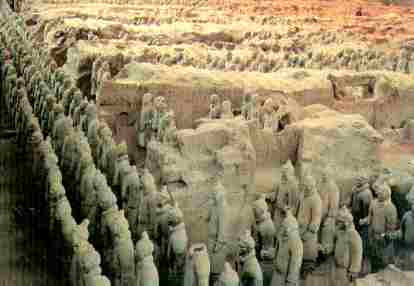
The Terra-cotta Soldiers of
Xi'an, China
Xi'an (pronounced Shian) is an ancient
city of 6 million people. (It's one of China's smaller cities!) It was the
domain of the first Chinese emperor, Qin (pronounced Chin) who united various
warring principalities about 200 B.C. Xi'an's most famous tourist site is near
Qin's mausoleum - 7 or 8,000 terra-cotta soldiers and cavalry. They call it the
8th wonder of the world and, in my estimation, it does qualify. Also, this city
was the terminus of the ancient "Silk Road". Although I was busy in my role as
a CESO Volunteer Adviser I was taken to see many fascinating tourist sites in
this historic area each weekend.
My impressions from this my
first visit to China
- August/September 1999:
- The crowds of cars, bicycles, mopeds
and every kind of conveyance imaginable has to be experienced to be
appreciated.
- Chinese people are courteous and
polite. This particularly shows in traffic, where the swarms of bicycles,
motorcycles and pedestrians compete with cars at intersections. In North
America it would give rise to much road rage. I have seen no indication
whatsoever of such an attitude.
- There are no crosswalks. Pedestrians
stroll nonchalant across many lanes of traffic. It seems to be an
unwritten rule that nobody runs. (That rule does not apply to me.)
- The main roads are surprisingly wide. I
expected the streets to be medieval. Not so for the principal roads. The city
is bisected about every couple of kilometers by wide modern well-kept roads.
Normally, in each direction, there are two lanes of auto traffic plus a two
lane road for bicycles and hand drawn carts as well as motorized ones. In
addition there is a very wide sidewalk for pedestrians (at least 4 times our
normal sidewalk's width). In some cases the auto traffic part of the roadway is
three or four lanes in each direction. The different categories of roadways are
separated by boulevards, planted with shade trees for the pedestrian and
bicycles - a smart move in this hot climate. This is also a place to wait for
the best time to stroll across the traffic. On September 7, it was 37c. They
sprayed water on the streets to cool things a bit.
- I have not found the pollution as bad
as I had been led to believe but it is very evident.
- Women with enormous floppy brooms keep
the gutters clean of debris. There is no graffiti and very little rubbish on
the streets or sidewalks.
- Chinese are particularly prompt - if
someone is late by three minutes the apologies are profuse.
- Chinese are friendly (and curious) with
foreigners. On the street, I am frequently greeted with a smile and a "Hello"
or "Neehow" (their version).
- All children take intensive classes in
English, starting in Middle School. Unlike most English Canadians taking
French, after a few years many can carry on a basic conversation in
English.
- They look for every opportunity to
absorb English pronunciation and vocabulary from a native speaker. My host
speaks quite good English. He learned as a teenager by talking to American
tourists - so his accent is sort of mid-western. Even at an early age he showed
entrepreneurial flare. He memorized the Gettysburg address and much American
history. So he would stand on the street near a favorite tourist site, reciting
Lincoln's address and attract the tourists to him rather than accosting them.
Then he would amaze them with his knowledge of the U.S.A. (He found that he
often knew more about U.S. history than many Americans!) What a salesman he was
- and still is.
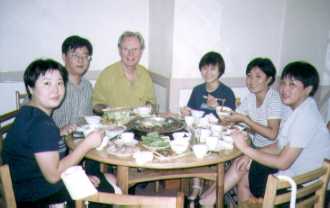 I was taken to many
different restaurants, featuring foods from various regions of China - a
variety of cuisine that surprised me. I became reasonably adept with
chopsticks. I was taken to many
different restaurants, featuring foods from various regions of China - a
variety of cuisine that surprised me. I became reasonably adept with
chopsticks.- Chinese have very different eating
protocol. My mother always said, "Bring your food to your mouth, not your mouth
to the food." Quite obviously Chinese mothers don't say that. I have become a
slurper with the best of them.
- With their socialist background,
Chinese are still learning about marketing, but watch out. They are learning
fast. Some say that the 21st century belongs to China and I would echo that
sentiment.
- My work as a "Canadian Expert in
Marketing and the Internet" has been rewarding for me and, I hope, useful to
the Chinese. I have given seminars to my host company and to several other
companies and had many other meetings with customers of my client. This economy
is shackled by certain government regulations (particularly in the area of
communications) but is being unshackled year by year. It's going to be
interesting if the process continues. I also created an English version of my
host company's web site. (They had an English version but it was very basic
and, like most written English that I have seen, not very good - they call it
"Chinglese". )
- In my experience, the Chinese are
exceedingly generous, with their time, their willingness to explain (like my
ill-fated endeavour to learn the official Chinese type of Tai-Chi) and the
gifts that they extend.
- Dr. Norman Bethune paved the way for
Canadians to receive a warm welcome. All children learn at school about his
self-sacrifice.
Some Highlights
as a
CESO Volunteer Adviser in Xi'an
My host company was Xi'an Eton
Enterprises. They put me up in the Xi'an Hotel, right next door to their office
building. I had heard many alarming tales about the inadequate facilities
offered by Chinese hotels. This may be true some places but from my experience
in Xi'an and Beijing I would say it does not apply to the major cities. My
Xi'an Hotel warrants a full four star rating.
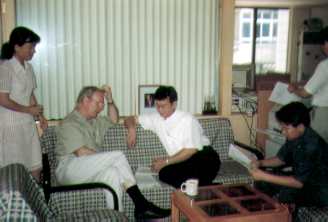 First I planned with Wilson Wang, president
of Xi'an Eton Enterprises and my host, what exactly I would do over my three
weeks' stint. On the left is Nan Hong who provided interpretation for most of
my meetings. Although, not for Wilson Wang who speaks very good
English. First I planned with Wilson Wang, president
of Xi'an Eton Enterprises and my host, what exactly I would do over my three
weeks' stint. On the left is Nan Hong who provided interpretation for most of
my meetings. Although, not for Wilson Wang who speaks very good
English.
My mandate was to give lectures to Eton's
employees on Marketing and the Internet, and in particular, E-commerce. We
quickly determined that it was premature to do more than an introduction to
E-commerce. However, there was much to be gained from a better understanding of
the marketing and sales process and how to use the Internet for marketing
research and marketing support. So I first gave a seminar to the Eton staff
(about 16). They are very enthusiastic and intelligent. I then adapted the
seminar for other groups. 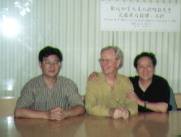
As it turned out, there were many
opportunities to be involved with Eton customers and prospects. Mostly this was
ad hoc, as clients came to the office. I was treated as the expert in many
different areas (One definition of an expert: a CESO volunteer who is willing
to jump into any situation.) For example, one facet of Eton's operations is the
creation of graphic designs for advertising and packaging. The client in this
picture was the owner of a local radio station and he was not very happy with a
billboard design that had been prepared. I was asked for my opinion. As it
turned out I was able to suggest that, instead of the call letters, they
incorporate the location on the radio dial. (To help people find it.) If you
think that Chinese are taciturn you are mistaken. The client was so
enthusiastic about my little suggestion that in a blaze of Chinese that I
couldn't begin to grasp, he came across the room shook my hand and gave me a
big hug. He then wanted to have his picture taken with me.
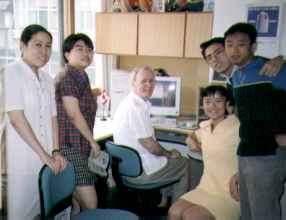 Here are several people
from the office who wanted to have their picture taken with me. I've never been
so popular Here are several people
from the office who wanted to have their picture taken with me. I've never been
so popular
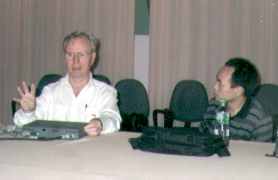 I prepared a PowerPoint
presentation on my notebook computer and gave a seminar in English (They
created a Chinese version) on "Marketing and the use of the Internet" to a
large company that are prospects for Eton's Technology Transfer division. The
fellow beside me handled the interpretation. (In this picture I am proving that
I am expert enough to count to four.) I prepared a PowerPoint
presentation on my notebook computer and gave a seminar in English (They
created a Chinese version) on "Marketing and the use of the Internet" to a
large company that are prospects for Eton's Technology Transfer division. The
fellow beside me handled the interpretation. (In this picture I am proving that
I am expert enough to count to four.)
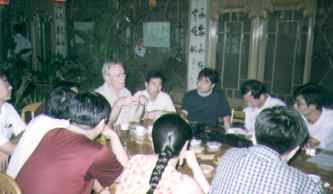
I spent an interesting Saturday afternoon
with the graduating class from the MBA program at a local university. (My host,
Wilson Wang, is a graduate of this program.) The meeting was scheduled to begin
at 2 P.M. and run to 4 P.M. Actually it ended around 7 P.M. I had some fun
giving everyone who didn't have an English name one that, to my ear, sounded
similar to their Chinese one. A few already had a name but one didn't like hers
so I did the honors and "re-christened" her. They had lots of good questions.
Towards the end of the get-together Wilson said, "Now, Frank, tell us a green
joke." It turned out that that is the Chinese way of saying off-colour
joke. Normally, I have no difficulty thinking of lots of jokes but it isn't
easy to think of one that lends itself to simultaneous translation. It doesn't
help either when the person who is doing the translating keeps asking "What's a
____" (fill in the blank). I made several attempts. One person laughed at one
joke. I'm in the market for stories that translate well.
As you may have suspected, I count this as
the experience of a lifetime. I won't forget my friends in China and I hope
that they benefit from my endeavors. This world is a global village and I have
had the privilege of visiting one of the suburbs and, I hope, contributing to
its closer relationship with the rest of us, as well as to our appreciation of
the Chinese people. |